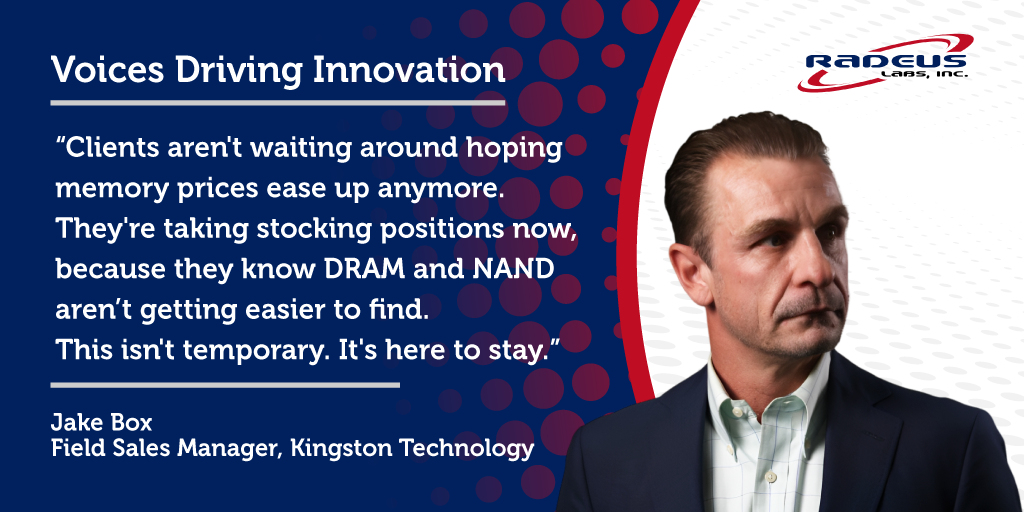




This is not a general market warning. This is an operational update for teams whose programs depend on SSDs or RAM and it affects current orders, delivery timelines, and budgets.
We have reached a milestone I did not expect to report: high-performance silicon now costs more than gold by weight. Two-terabyte SSDs have crossed the $1,000 price point. RAM that was $32 a stick not long ago is fetching $500. But the price number alone is not the most important part of this update. What matters more is the fulfillment environment those prices reflect and what your team needs to do differently right now.
Why Your Supplier Relationships Are Not Enough
A common misconception in this market is that strong supplier relationships provide insulation from supply constraints. They help, but there is an important distinction to understand.
Integrators are not foundries. That difference matters enormously right now.
The actual production of NAND and DRAM wafers is controlled by a small number of primary foundries. Every integrator, regardless of size or reputation, depends on those foundries for raw supply. And those foundries are allocating capacity based on margin, not relationships. The highest-margin buyers, primarily large AI infrastructure companies, are locking up wafer supply ahead of everyone else. No integrator relationship, however strong, bypasses that upstream reality.
This is a structural condition, not a temporary bottleneck. The organizations navigating it best are the ones who understand where the actual constraint lives and plan accordingly.
What Is Happening to Orders
The fulfillment environment has changed in ways procurement teams need to understand.
The traditional queue-based model has broken down industry-wide. Allocations are arriving in fragmented, unpredictable increments. More significantly, the market has shifted to spot pricing, which means orders placed months ago are subject to repricing based on today's rates, not the price at time of order. The quote you received in December is likely not the number you will pay today.
Global RAM allocation for all of 2026 is already more than 95% committed. Samsung has announced price increases exceeding 100% while holding extremely tight inventory. For many SKUs, the window to secure components at any predictable price has already closed.
The Gray Market Is a Security Problem, Not Just a Procurement Risk
When official channels tighten, the instinct is to look elsewhere. We want to be direct about what that means in practice.
The current shortage has produced a surge in sophisticated counterfeits and non-compliant hardware moving through non-traditional channels. For mission-critical programs, this is not simply a quality concern. It is a security concern. Components with unknown provenance and no validated chain of custody represent a real vulnerability in systems where failure is not an option.
At Radeus Labs, we maintain strict compliance standards and conduct rigorous hardware validation on every component that enters our supply chain. That discipline is not a formality. It is the only way to ensure that nothing compromised or fraudulent reaches your systems. The gray market, however tempting when lead times stretch, is not a safe shortcut for programs operating at this level.
What Your Team Should Prioritize Now
The following actions are not long-term strategic recommendations. They are immediate steps for teams managing active programs in this environment.
- Reframe procurement around deployment need. Know which of your programs are most time-sensitive and communicate that clearly. The market is not moving in a predictable order, and your procurement strategy should not assume it will.
- Build repricing variability into your budgets now. Spot pricing is the current reality across the market. Absorbing that as a surprise mid-program is a harder problem than planning for it in advance.
- Do not rely on gray market sourcing for mission-critical components. The security and compliance risks are not worth the short-term availability gain.
- Get into the queue with real purchase orders. Speculative planning does not secure allocation. A committed order does. Without one, you are not in line at all.
The market has fundamentally changed, and the fulfillment models built for a different environment need to change with it. At Radeus Labs, we are committed to navigating this with you directly, with transparency about what is available, what is at risk, and where your programs stand.
The window is still open. Reach out to our team and let's talk about where you are.

— Juliet Correnti is the CEO of Radeus Labs, a U.S.-based cleared facility and ISO 9001 certified manufacturer of satellite communication and computing systems for military, infrastructure, aerospace, government technology solutions, and public safety environments.