

CASE STUDY: Some products are designed once and deployed for years. The Digital Flight Recorder (DFR), however, has continuously adapted alongside the missions it supports for more than two decades.
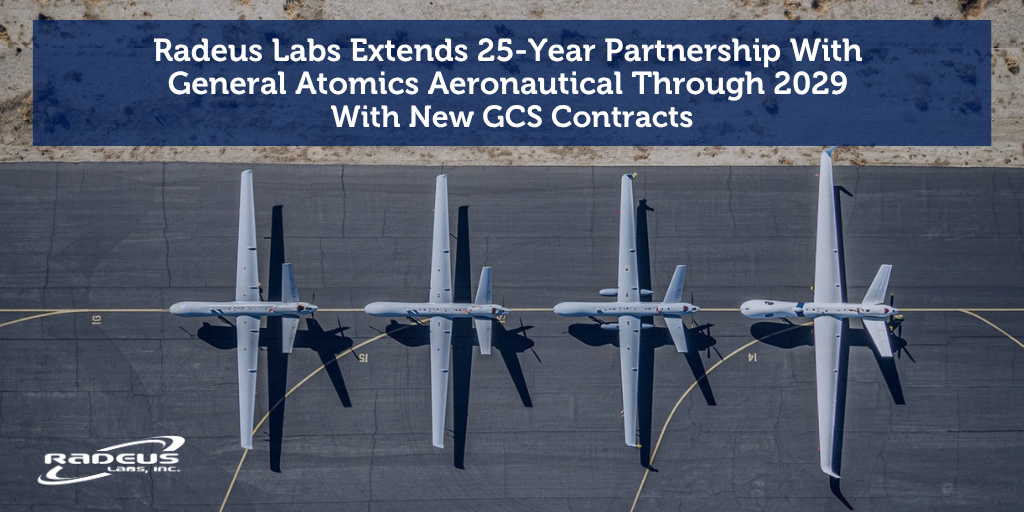
Since 2005, Radeus Labs has partnered with General Atomics Aeronautical Systems (GA-ASI) to advance the digital and analog recording systems used by unmanned drone pilots and payload operators. What began as a general-purpose video capture computer to replace obsolete Hi-8 tape recorders is now a sophisticated embedded device platform. Across three hardware generations and ongoing software updates on the current platform, nearly 3,000 units have been fielded to date.
The Challenge
As unmanned missions grew more complex over the lifespan of the program, Radeus Labs had to hit a constantly moving target of shifting technical requirements:
- Obsolete Recording Media: The program needed to phase out aging, unreliable Hi-8 tape recorders in favor of a modern digital recording solution.
- Proprietary Metadata Synchronization: Dictated by an unusual and complex legacy requirement, the system had to digitize analog video feeds while perfectly time-synchronizing proprietary metadata as serial-over-audio.
- Shifting Video Standards: The emergence of HDMI and DVI in the early 2000s meant the platform had to quickly pivot away from analog-only capture hardware.
- Hardware Obsolescence: Relying on commercial-off-the-shelf (COTS) capture cards and components introduced long-term obsolescence risks as production scaled.
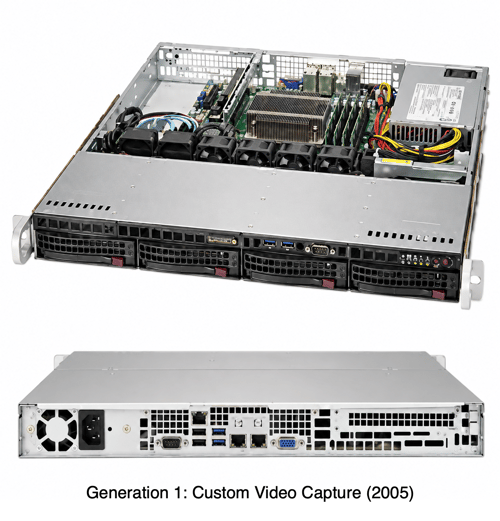
- Form Factor Constraints: The initial proof-of-concept setups relied on general-purpose computing rigs that took up far more valuable space than the operational environment allowed.
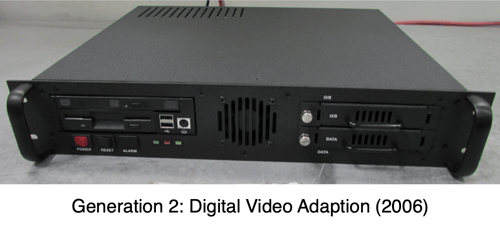
Generation 2: Digital Video Adaptation (2006)
When digital interfaces like HDMI and DVI began replacing analog composite and VGA standards, the platform adapted. Radeus introduced a new variant (VDVR) featuring a different commercial capture card designed for digital video interfaces. To streamline the footprint, both the analog and digital platforms were consolidated into a single, customized 2U chassis that slashed unnecessary bulk and better met strict design constraints.
Generation 3: From Custom Computer to Embedded Device (2014)
The DVR and VDVR platforms proved highly successful, with more than 1,000 units deployed over the next eight years. However, by 2014, the first critical component obsolescence issue hit the VDVR line.
Rather than a temporary fix, Radeus leveraged nearly a decade of field service and repair intelligence to build a radically more robust, secure, and internally controlled embedded platform. Knowing a single architecture could solve multiple problems at once, the engineering team designed a single embedded platform capable of replacing either the DVR or VDVR configuration. This consolidation allowed the customer to target a massive reduction in overall system rack footprint, driving it down from 12U to 4U.
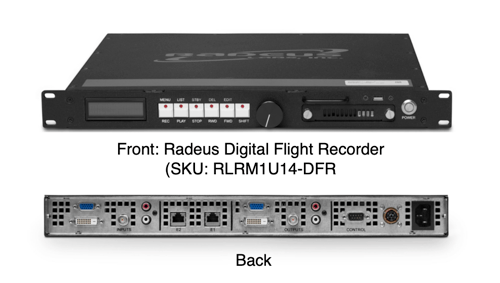 The result was a total rebranding: the Digital Flight Recorder (DFR). Built from the ground up with long-life embedded components, the platform was engineered to be offered as a 20-year lifespan product. The individual DFR unit itself was packaged as an ultra-rugged 1U rackmount enclosure featuring intuitive front-panel HMI controls and a highly customized embedded Linux OS. It was rapidly adopted across the fleet to replace aging DVR and VDVR units.
Continued Software Evolution (2014-Present)
With nearly 2,000 units deployed and more than a decade of proven field service since its 2014 debut, the DFR architecture continues to serve as the definitive solution for airborne ISR content. Instead of requiring new hardware cycles, the platform has seamlessly absorbed advanced capabilities via software updates, including:
- IP multicast capture and playback for H.264 and H.265 video
- KLV-A and KLV-B streaming metadata capture and playback
- Direct support for custom and proprietary metadata formats
- A streaming-only (multicast capture/playback) virtual device variant optimized for hypervisor environments
Key Technical Highlights
By transitioning from commercial-off-the-shelf configurations to an in-house embedded architecture, the platform achieved a rare balance of high performance, ruggedization, and lifecycle stability:
- More Than Two Decades of Program History: A single, enduring program partnership spanning from 2005 to today, sustained by three strategic hardware generations and continuous software agility.
- Nearly 3,000 Units Fielded: A massive deployment footprint consisting of more than 1,000 legacy DVR/VDVR units and nearly 2,000 modern DFR units.
- 67% Reduction in System Rack Footprint: Streamlining multiple legacy recording systems into a single, consolidated embedded architecture successfully shrank the overall rack footprint from 12U down to 4U.
- 20-Year Product Lifespan: The embedded DFR architecture was intentionally designed and component-selected to be offered as a 20-year lifespan product line.
- Improved Management of Obsolescence Through Internal Design: Migrating to an in-house embedded design in 2014 broke the cycle of COTS dependency, granting Radeus total control over component lifecycles and long-term support.
- Standards Adaptability: Seamlessly bridged the technology gap from legacy analog and early digital (HDMI/DVI) to modern IP multicast (H.264/H.265) video pipelines.
- Compact, Rugged Packaging: Transformed an oversized 2U general-purpose PC setup into an ultra-rugged, highly optimized 1U embedded rackmount chassis.
- Virtualization Support: Future-proofed for modern cloud and server architectures with a streaming-only virtual device variant tailored for hypervisor environments.
The Impact
Beyond the technical milestones, the continuous evolution of the platform delivered profound operational and financial advantages to the program:
- Successful Replacement of Obsolete Recording Hardware: Relieved the program of fragile, tape-based constraints by introducing a resilient digital recording architecture that has adapted across more than twenty years of active history.
- Scale and Longevity: Proven manufacturing and lifecycle stamina, with nearly 3,000 combined units fielded across multiple technology generations.
- A Field-Proven Solution: The DFR remains a trusted, high-reliability cornerstone for handling mission-critical airborne ISR content.
- Adaptability to New Technology: Rather than forcing costly, ground-up hardware redesigns, the product family has gracefully accommodated new video interfaces, complex metadata standards, and virtualization models.
- Improved Management of Obsolescence Through Internal Design: Transitioning the core embedded design in-house in 2014 effectively insulated the program from supply chain volatility and component end-of-life risks.
Why It Matters
Modern airborne ISR programs cannot afford to completely scrap and replace recording architectures every time a video standard changes or a commercial component goes obsolete. The evolution from the DVR to the DFR demonstrates how a product family can deliberately progress through planned hardware generations, matching the stride of rapid technological advancement while safeguarding the customer's long-term capital investments.
Radeus Labs brings:
- Long-Term Engineering Support: Decades of uncompromised commitment to a single, high-stakes defense program across multiple hardware iterations.
- Obsolescence-Aware Design: Deep-rooted experience developing proprietary embedded platforms specifically to secure component lifecycles and guarantee long-term supportability.
- Standards Adaptability: Elite multi-domain engineering expertise spanning video, metadata, and modern networking to layer cutting-edge capabilities directly onto established platforms.
- Built for the Long Haul: A deliberate design philosophy backed by platforms engineered to be offered as 20-year lifespan products.
- Field-Validated Scale: Real-world reliability, proven by nearly 3,000 units fielded over the program's history.
Your Next Long-Lifecycle Platform Starts Here
If your program demands a mission-critical recording or embedded computing platform designed to outlast supply chain volatility and absorb decades of shifting technology standards, Radeus Labs is ready to build it.
Contact our Sales team today to discuss how an expert custom embedded solution can protect your platform’s operational life and long-term supportability.