

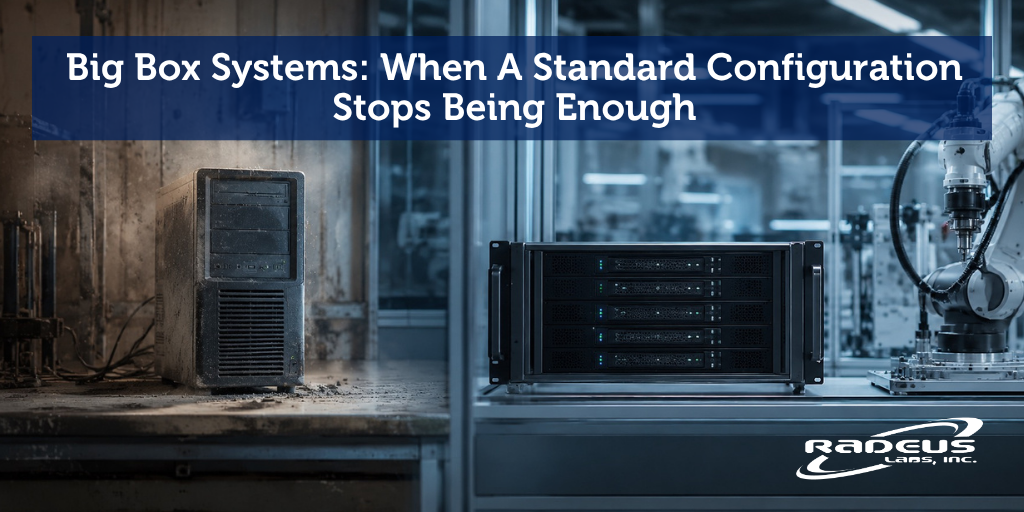
Big-box computers are built for broad use. Mission-critical industrial systems are not.
In test labs, data acquisition platforms, and robotics environments, the computer has to withstand vibration, temperature swings, dust, and continuous operation while supporting the interfaces, component availability, and service life the larger program requires. A standard specification sheet covers very little of that.
More companies are choosing systems engineered and integrated for the application instead of adapting around a stock configuration.
The Cost and Lifecycle Problem
For years, engineering teams could start with a mass-market commercial platform and design around its limitations. That's getting harder. Buyers report steep price increases from large vendors over the past year, and hardware generations are turning over faster than program schedules.
That mismatch is the real problem. The computer is rarely a standalone product — it usually sits inside a larger system: rack-mounted test equipment, a data acquisition rig, a robotics platform. That larger system is qualified, tested, and supported on its own timeline, which is often much longer than a commercial hardware generation now lasts. When the underlying platform changes or disappears mid-program, the surrounding system has to absorb the disruption.
The consequences show up as redesigns, requalification, new software testing, and support gaps. A lower initial hardware price doesn't create much value if the program ends up absorbing those costs repeatedly.
What Mission-Critical Applications Require
Engineers working in the field and on the test floor tend to prioritize the same capabilities:
- Long-lifecycle component planning, with supply consistency and controlled substitutions so a system designed today can still be produced and supported years from now.
- Application-specific engineering and validation, including configuration decisions based on vibration, temperature, dust, continuous duty cycles, processing requirements, and specialized interfaces.
- A computing partner who understands how the hardware fits into the customer's equipment and can support that configuration for the life of the program.
That last point is easy to underestimate. Teams integrating computers into their own products are not simply purchasing a box. They are choosing a platform, an engineering approach, and a support relationship that may remain part of the program for a decade or more.
The Difference Is in the Engineering
The distinction isn't between commercial and purpose-built technology. It's in how the two come together. The approach is to start with proven commercial components and build around the application: selection, configuration, integration, and support all tied to a specific set of requirements: environmental conditions, interfaces, expansion, lifecycle planning, validation, and change control.
The components themselves are often widely available. What determines whether the resulting system fits its application is the engineering applied around them.
Two Markets Driving Demand
Data Acquisition and Testing
Data acquisition and testing environments place unusual demands on computing hardware. Shock and vibration test labs, for example, may integrate a computer directly into a rack-mounted system that must run continuously, process large data streams, and withstand repeated physical stress.
A mass-market system may meet the baseline processor and memory requirements, but the standard configuration may not address mounting, airflow, specialized I/O, environmental exposure, or long-term configuration control. Engineering the system around those requirements reduces the risk that the computer becomes a weak point in an otherwise carefully designed platform.
Robotics and Automation
Plant-floor computing faces a different version of the same problem. It operates around constant motion, airborne particulate, temperature variability, and production schedules that don't pause, while integrating with control systems, sensors, and other equipment on the line.
As automation expands, these platforms are expected to process more data locally and respond in real time. A collaborative robot on a production line doesn't sit in a climate-controlled server room. Its computing has to be engineered for the conditions, workload, and integration requirements it faces every shift.
"Customers are putting more weight on long-lifecycle hardware and stable configurations than they did a few years ago," says Clay Moore, Technical Sales Representative at Radeus Labs. "Almost nobody asks whether commercial components will work. They ask whether the complete system is designed and supported for the application."
Closing the Configuration Gap
Big-box systems have an important place in commercial computing. The gap appears when a standardized configuration is expected to satisfy nonstandard environmental, integration, lifecycle, or support requirements. Purpose-built computing closes that gap by applying engineering, validation, and lifecycle planning to the full configuration from the start.
Does Your System Need More Than a Standard Configuration?
Companies across industrial sectors are reassessing whether their current computing platforms can support the next phase of their programs. Rising prices and shorter product cycles are part of the pressure, but the larger question is whether the hardware configuration matches the application it is expected to serve.
Radeus Labs builds long-lifecycle, ruggedized computing systems for harsh environments, with the engineering and supply continuity required for mission-critical programs. If you are evaluating whether a big-box configuration can meet your requirements, we'd welcome a conversation about the workload, environment, interfaces, and lifecycle your system demands.

 Over the past few weeks, the Radeus Labs team has been on the road connecting with customers, partners, and new industry contacts. Computing and Recording Specialist Clay Moore attended