

For over a year, memory has been the tightest link in the supply chain for anyone building serious compute. DRAM and NAND prices have climbed beyond forecasts, and manufacturers are being more selective than ever about who gets product and when.
Jake Box has a front-row seat to the market. As Kingston Technology’s West Coast Field Sales Manager for system integrators, he works primarily with builders of AI servers, government systems, and gaming rigs. We spoke with him about what is driving the crunch, how Kingston manages allocation, and why this cycle differs from those before it.
A Shortage Turbocharged by AI
Jake says the shortage accelerated sharply at the end of last year and that this cycle differs from prior shortages because hyperscalers and AI infrastructure buyers have added a major new source of demand.
Memory shortages are cyclical: manufacturers expand capacity, oversupply drives prices down, and investment in new fabs slows. That caution limited capacity growth in recent years.
Jake describes AI demand as a new force layered onto an already cyclical market:
"It's almost like a completely new demand that came out of nowhere. Hyperscalers and AI infrastructure buyers are now competing for the same limited supply as everyone else, layering a new, sustained baseline of demand on top of the market's normal ebb and flow. AI's appetite for memory isn't going anywhere."
Living Inside Allocation
 With demand outpacing supply, Kingston allocates limited product across customers each week rather than filling every order as it arrives. The approach helps manage the shortfall, but it does not make the math any easier.
Kingston prioritizes long-standing relationships and focus accounts, but even preferred customers are not insulated. Jake describes a common scenario: a customer needs 2,000 units, but supply may take 10 weeks to fulfill through a phased delivery plan.
Jake puts the reality of allocation plainly:
"I can't sell you what I don't have. All I can do is tell you the truth and build a plan around it."
Customers understand the constraints better than they did a year ago. Previously, Jake had spent years trying to win some customers’ business, only to have supply constraints prevent Kingston from supporting new volume when the opportunity finally arose. The conversations remain difficult, Jake says, but they no longer start from scratch.
The Shortage Isn't Easing, It's Spreading
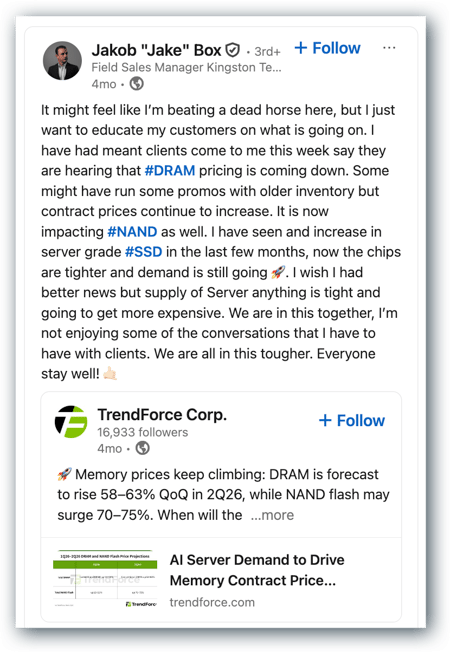 Jake says the crunch now extends beyond DRAM. Server-grade SSDs and NAND have tightened in recent months. He also regularly shares his market observations and pricing updates on LinkedIn.
For Jake, that spread indicates that customers do not expect a quick market correction.
Jake says he is seeing customers respond by securing supply earlier:
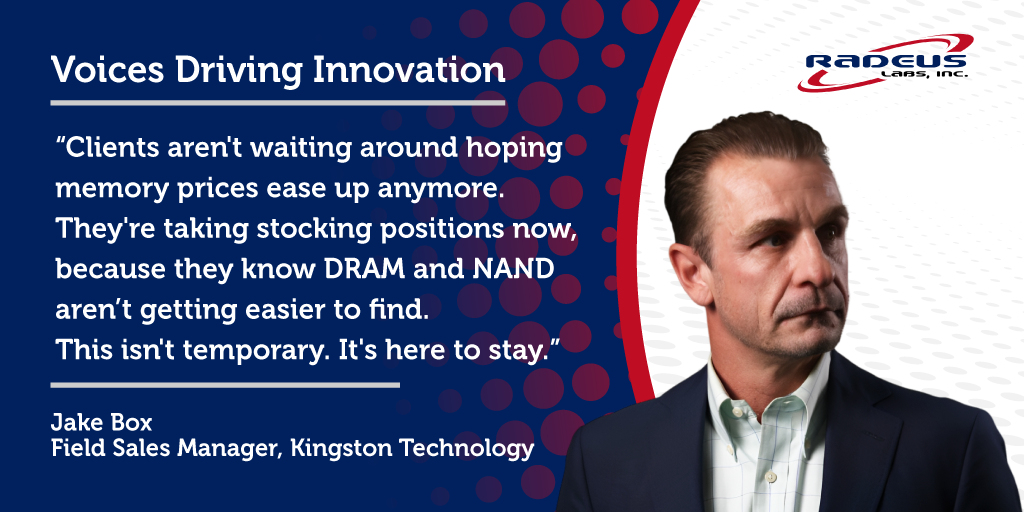
“Clients aren’t waiting around hoping this eases up anymore. They’re taking stocking positions now because they don’t expect near-term relief. AI-driven demand has become a durable part of the market, not a passing spike.”
Reading the Market
Jake reviews industry sources each morning, including DigiTimes, Tom’s Hardware, and TrendForce, to track supply and pricing. He says he often uses AI to help draft market updates, but he checks the numbers against current conditions and rewrites the message in his own voice.
Jake explains the limitation of using AI for market communication:
“AI can draft an update, but it can’t always tell you the number’s already out of date.”
He also resists fully automating his research. Narrowly focused tools can miss broader signals, from OEM strategy changes to geopolitical developments, that may affect customer planning.
The Radeus Labs Relationship
 Jake has recently taken a more direct role in Kingston’s relationship with Radeus Labs, supporting the government, server, and hypervisor projects that make up a significant part of Radeus’s business. He sees both companies as valuing long-term partnerships and loyalty to vendors and customers that have proven reliable over time.
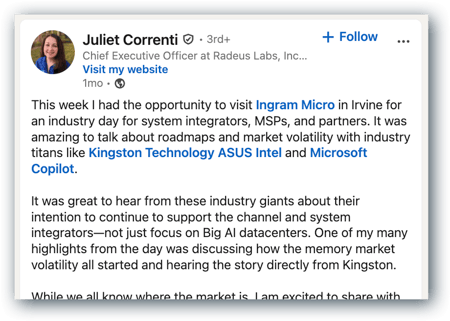
That relationship deepened at Kingston’s recent System Integrator Summit, where Radeus Labs CEO Juliet Correnti attended as a guest. The event gave Jake a clearer view of Radeus’s business and where Kingston can add value. Correnti later shared that hearing Kingston explain the origins of memory-market volatility firsthand was one of her highlights from the visit.
Communication as a Value-Add
For Jake, communication is a key value-add Kingston provides. In a market where no supplier can promise everything a customer wants, Kingston’s sales team helps customers plan by providing clear, realistic information.
Jake emphasizes the stakes for smaller system integrators:
"Not everybody is a 5,000-plus employee customer. Many of the system integrators we support are smaller businesses, without the large purchasing teams, inventory reserves, or ability to absorb prolonged supply disruptions that larger enterprises may have. We do our best to provide clear information about availability and delivery timing to help them plan builds, meet customer commitments, and keep operations moving.”
About Voices Driving Innovation: Radeus Labs' ongoing interview series featuring the engineers, advisors, and industry leaders shaping the future of high-performance computing, SATCOM systems, and mission-critical technology.

 Over the past few weeks, the Radeus Labs team has been on the road connecting with customers, partners, and new industry contacts. Computing and Recording Specialist Clay Moore attended