

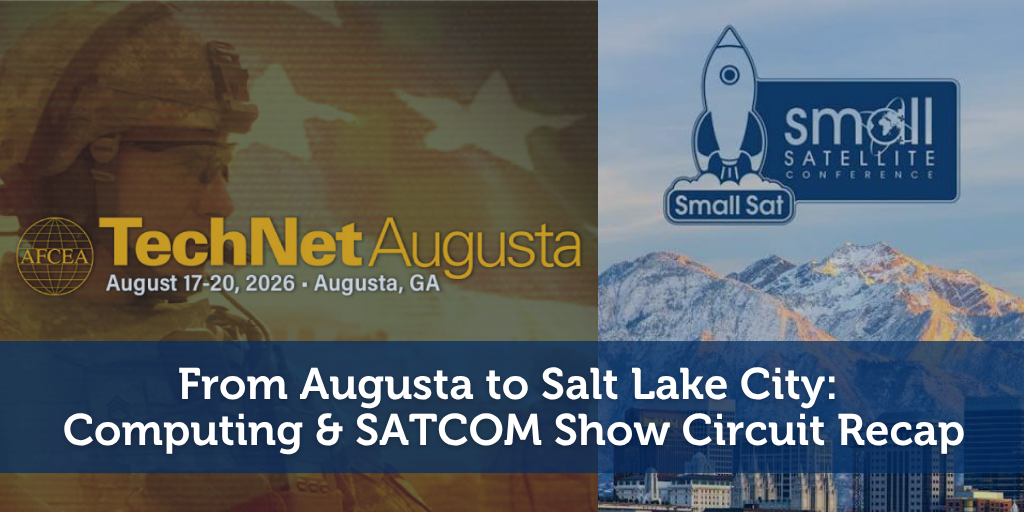
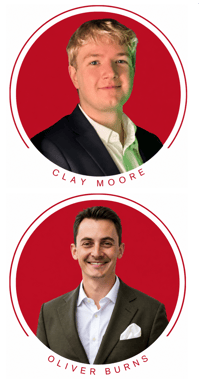
 Over the past few weeks, the Radeus Labs team has been on the road connecting with customers, partners, and new industry contacts. Computing and Recording Specialist Clay Moore attended AFCEA TechNet Augusta and MODSIM World in Alexandria, while Satcom Specialist Oliver Burns traveled west to SmallSat in Salt Lake City.
Clay’s stops highlighted the growing importance of military modernization and rugged tactical edge compute. At SmallSat, Oliver encountered a different but related conversation: how cloud-first approaches and AI may reshape commercial ground-segment operations.
Here's what stood out at each stop.
AFCEA TechNet Augusta: Cyber, C2, and the Tactical Edge
 AFCEA TechNet, held in Augusta, Georgia mid-August, was the larger of Clay's two stops, with more exhibitor conversations and a broader military-technology focus than MODSIM World.
Augusta's proximity to Fort Eisenhower and its broader cyber and intelligence ecosystem helps explain the event's focus on military communications, cybersecurity, and modernization.
Three themes stood out across the show:
- Army modernization, with a strong focus on Next Generation Command and Control (NGC2)
- Interoperability, through open architectures designed to let systems talk to one another
- Tactical and edge computing, the layer that powers all of the above, and squarely where Radeus Labs fits in
Who we connected with:
- Gilat Datapath – It was great to reconnect with the team and learn more about their work supporting defense and government connectivity.
- By Light – A major presence at both AFCEA and MODSIM this year, between its Cole Engineering Services (CESI) subsidiary at AFCEA and Dignitas at MODSIM World.
- High Sec Labs – Makers of KVM switches and other peripheral hardware built for high-security environments; always a good conversation with their team.
The overarching message at AFCEA was speed: the companies standing out are the ones that can innovate and field solutions faster and more cost-effectively than legacy procurement cycles typically allow.
MODSIM World 2026: Vision, Autonomy, and Edge Compute
Clay also attended MODSIM World in Alexandria in August, where military modernization took shape through modeling, simulation, autonomy, and human-machine interaction. Held in Alexandria Virginia this year after moving from Norfolk, the event felt livelier in its closer-to-D.C. setting. The sessions Clay attended explored how AI, autonomy, and edge computing are converging in mission-focused environments.
Clay noted that Sterling Computer stood out with a talk titled Autonomous Vehicles and Unmanned Systems: Vision Clarity at Mission Speed, covering AI-driven vision processing built to cut through dusty or visually obstructed environments, exactly the kind of workload that depends on rugged, tactical edge compute running close to the field.
Two other sessions worth calling out:
- George Mason University presented on multi-vessel, coordinated eye-gaze control: a single operator uses eye tracking to steer one autonomous surface vessel, while a fleet of smaller boats autonomously holds formation and follows along.
- Dignitas, a By Light company, spoke on integrating AI models into battlefield awareness, including anomaly detection and situational awareness.
We also reconnected with VMASC (the Virginia Modeling and Simulation Center) and learned more about Old Dominion University's newly announced National Security Institute,which is designed to engage industry partners in national-security research and technology solutions.
The throughline across the floor: a mature, fast-moving ecosystem of manufacturers, integrators, and resellers, all trying to pivot quickly enough to keep pace with military modernization priorities.
SmallSat 2026: Cloud, AI, and the Evolving Ground Segment
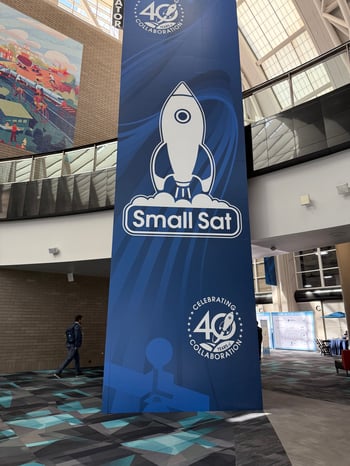 While Clay's stops centered on military and government modernization, Oliver Burns carried the conversation west to SmallSat's commercial-space ecosystem in Salt Lake City, focusing primarily on reconnecting with existing customers, discussing active and upcoming projects, and meeting new contacts.
Oliver noted that the event has grown substantially, moving from its earlier university-based setting to the Salt Palace Convention Center. Alongside that growth, he noticed a broader mix of AI- and data-focused companies entering the commercial-space conversation.
One theme emerging from those discussions was a cloud-first approach to commercial operations, informally described as "clouds above the clouds." Some vendors are exploring how cloud-based software and AI could shift selected functions away from conventional ground stations and teleports. For Radeus Labs, the conversation reinforces the enduring need for resilient, physical ground-segment infrastructure, particularly in government and military environments.
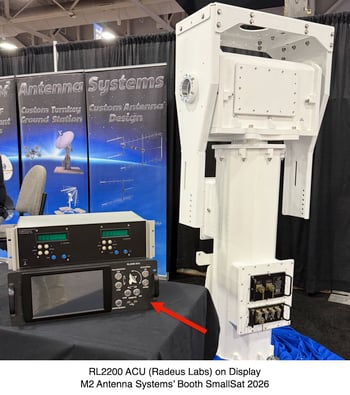 Who we connected with:
- M2 Antenna Systems Inc. – M2 displayed a Radeus Labs RL2200 ACU at its booth, reflecting the companies' ongoing partnership.
- Space Ops New Zealand – A promising new connection with a ground station operator in New Zealand.
- SSC Space – Another promising ground segment conversation for the team to follow up on.
Just as important were the face-to-face conversations with existing customers: checking in on current work, discussing what's ahead, and comparing notes on the direction of the industry.
What's Next: IBC 2026 in Amsterdam
With ground-segment and satcom conversations top of mind after Salt Lake City, Oliver is headed to IBC 2026 in Amsterdam next, Radeus Labs' biggest show of the year. IBC takes place September 11–14 at RAI Amsterdam.
If you'll be there, Oliver welcomes the chance to connect about ground-segment infrastructure, antenna control systems, and current teleport requirements. You can schedule a meeting with Oliver here.
Hope to see you there!