

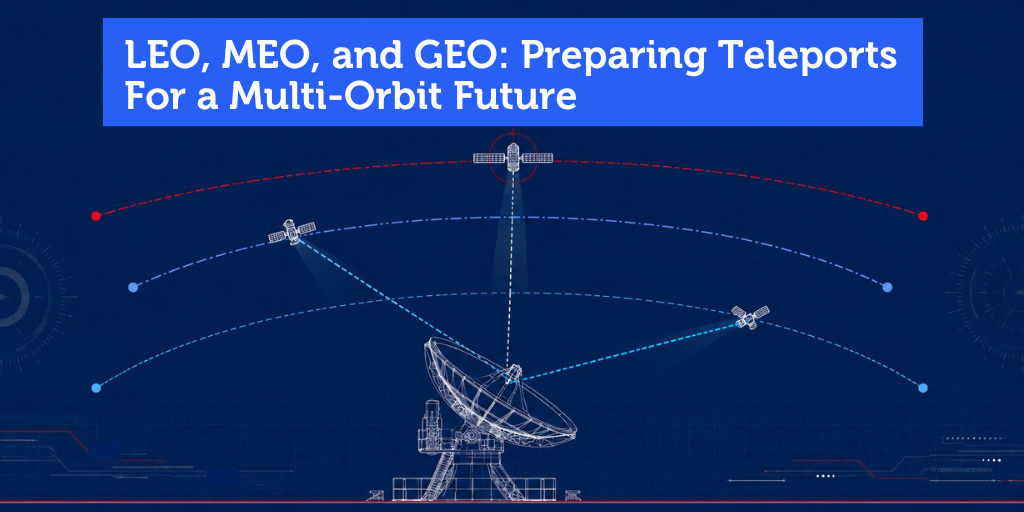
For decades, much of satellite ground infrastructure was built around a predictable model: point an antenna toward a geostationary satellite and keep it there.
Today, some teleports, particularly defense, gateway, test, and other high-performance sites, are being designed or upgraded to support more than one orbital regime. The continued expansion of low Earth orbit (LEO) networks alongside medium Earth orbit (MEO) and geostationary orbit (GEO) services is creating new demands on the ground systems supporting them.
Recent industry activity also highlights the continuing strategic value of LEO communications networks. Rocket Lab and Iridium, for example, have announced a proposed acquisition, subject to shareholder, regulatory, and other customary approvals. The deal would combine Rocket Lab's launch and spacecraft capabilities with Iridium's global LEO communications network.
The development does not mean every teleport needs to support every orbit. It does underscore an important question for ground operators: How adaptable is today's infrastructure if tomorrow's mission requires a different orbital regime?
Multi-Orbit Changes the Control Requirements
Because geostationary targets remain fixed in the sky while low Earth orbit satellites move rapidly through the sky, these different orbital regimes place materially different demands on an antenna control system.
GEO operations often emphasize long-duration pointing stability, while LEO operations add demanding slew, acceleration, and pass-tracking requirements. MEO introduces an intermediate, mission-dependent tracking profile. Depending on the band, antenna size, beamwidth, and mission, all three can require very high pointing accuracy.
In one deployment supporting a U.S.-related program, Radeus Labs provided the antenna-control solution for a new teleport facility designed to acquire and track satellites across GEO, MEO, and LEO. The mission required sub-arcsecond pointing accuracy of ±0.0001° while controlling large reflector antennas with significant mechanical inertia.
Radeus configured dual azimuth motors to support fast LEO passes while retaining the fine-grain stability required for GEO tracking. The company reports that the system achieved the required precision across its operational modes.
But antenna movement is only one piece of LEO and multi-orbit operations.
Continuous communications can also depend on multiple antennas, gateway diversity, accurate orbital data, compatible RF and modem infrastructure, network orchestration, spectrum and beam management, and procedures for transferring service as satellites enter and leave view. A tracking antenna alone does not make those handoffs seamless.
Making Multi-Orbit Tracking More Manageable
The antenna control layer can, however, remove some of that complexity.
For that deployment, Radeus developed a custom scheduler application integrated with its 9000 Antenna Control System (ACS). Operators could pre-program acquisition windows for multiple satellites, while the system dynamically allocated antenna resources to reduce idle time and manual intervention.
The system was also configured to switch between LEO, MEO, and GEO profiles, automatically adjusting slew rates, acceleration curves, and tracking modes.
For a facility supporting different missions, that adaptability can reduce the need to treat every orbital regime as an entirely separate antenna-control problem.
Modernization Does Not Always Mean Starting Over
Supporting new missions does not necessarily require replacing otherwise serviceable antenna infrastructure.
The deployment involved a non-standard pedestal, multiple motors, a large reflector, and substantial mechanical inertia. Rather than requiring a redesign of the pedestal or reflector support, Radeus adapted the 9000 ACS to the site's mechanical configuration.
That illustrates an important consideration for operators evaluating new tracking requirements. An existing antenna may still have years of useful service ahead, while its control system may have been designed around a narrower mission profile.
Where the antenna structure, drives, sensors, RF chain, safety systems, and link requirements remain compatible, upgrading the control layer can add capabilities without replacing the entire ground system.
Preparing Ground Infrastructure for What Comes Next
Not every teleport needs LEO, MEO, and GEO capability. But for high-performance and mission-specific facilities being asked to support changing satellites, missions, and orbital profiles, flexibility is becoming an important design consideration.
Radeus Labs' Custom Antenna Control Systems for High-Performance SATCOM Installations case study examines one such deployment, including multi-orbit tracking, integrated scheduling, custom hardware integration, and the commissioning process used to meet its stated sub-arcsecond pointing requirement.