

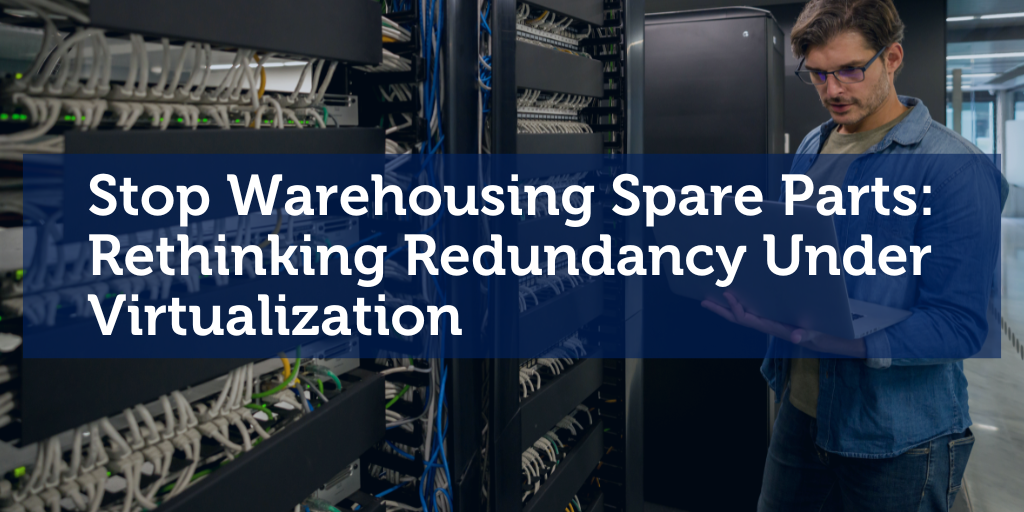
Redundancy historically has meant lots and lots of hardware. If a system was critical, additional workstations or servers were purchased. Full systems were boxed and stored as spares to ensure availability. In a one-to-one computing world, that approach made sense. Workloads lived on specific machines, and when a machine failed, replacement was the only path to recovery.
Virtualization breaks that relationship. Workloads are no longer inseparable from individual pieces of hardware, yet many organizations continue to apply legacy redundancy and sparing strategies to architectures that no longer operate that way. The result is unnecessary cost, unused inventory, and avoidable complexity in virtualized environments.
The Limits of Traditional Redundancy
In traditional architectures, redundancy depended on duplication. Programs identified critical systems and purchased complete backups, sometimes multiple layers deep, to guarantee uptime. In mission-critical environments, those spares were often never deployed. They sat on shelves for years, aging quietly until they were obsolete before ever being powered on.
The intent was sound. The execution was inefficient.
Budgets were spent protecting against failures that rarely occurred. Sustainment teams inherited hardware that was difficult to support. Long lifecycle programs absorbed the cost of redundancy that existed more in theory than in practice. That model only worked because workloads were tightly bound to the hardware running them. Virtualization changes where work happens, and therefore where redundancy belongs.
Where Redundancy Lives Under Virtualization
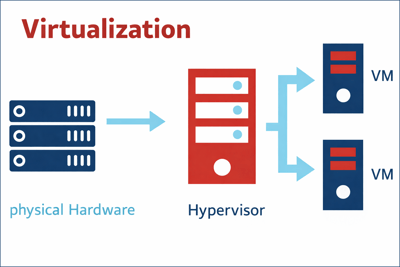 In a virtualized environment, applications and operating systems run as virtual machines on a shared platform for high-performance virtualization servers. They are no longer tied to a specific endpoint.
Redundancy shifts from individual machines to system design.
Instead of duplicating entire workstations or servers, redundancy is achieved through shared infrastructure and multiple access paths. Endpoints become interfaces rather than execution platforms. If an endpoint fails, another can connect to the same virtual environment without interrupting the underlying workload.
This is often where confusion appears. Redundancy feels less tangible because it is no longer expressed as a physical spare sitting nearby. But the system itself is often more resilient. Failure domains are smaller, recovery is faster, and availability is determined by architecture rather than inventory.
Sparing Follows the Architecture
As redundancy moves, sparing must move with it.
In a virtualized model, sparing focuses on access and infrastructure rather than complete systems. This reduces the amount of high-value hardware sitting idle and lowers the risk of obsolescence. Instead of maintaining shelves of boxed systems that may never be used, organizations maintain fewer, more flexible spares aligned to how the system actually operates.
This shift has clear downstream effects:
- Less unused inventory aging out of support
- Lower sustainment and storage burden
- Faster recovery when failures occur
- More predictable long-term support
Sparing becomes intentional rather than defensive.
Why This Change Is Often Resisted
Traditional redundancy was visible. Virtualized redundancy is architectural.
That difference creates hesitation, especially in environments where uptime, compliance, or mission success are non-negotiable. Stakeholders ask where the backup system is, or how availability is guaranteed without duplicate machines. These questions are reasonable, but they are rooted in assumptions from a computing model that no longer applies.
Virtualization does not remove redundancy. It redefines it. Reliability becomes a function of design, not duplication.
One Architecture, Many Stakeholders
This shift affects multiple groups, each with different priorities:
- Developers often overbuild during R and D to preserve flexibility
- Operators value quick recovery and consistent access
- IT and security teams prioritize centralized control and reduced attack surface
- Sustainment teams care about lifecycle risk and inventory burden
Virtualization works best when redundancy and sparing are discussed early and across all of these perspectives. When legacy assumptions persist, cost and complexity return quickly.
Designing for Virtualization From the Start
Virtualization does not eliminate the need for solid engineering. Hardware selection, storage, networking, and power design still matter. The difference is that these decisions now support a shared platform rather than isolated systems.
When designed intentionally, redundancy becomes systemic, sparing becomes strategic, and long-term support becomes simpler rather than harder.
What This Looks Like in a Real Program
.png?width=200&height=277&name=Ebook%20Digital%20Reader%20-%20Monica(21).png) This approach is reflected in Radeus Labs’ work with GET Engineering, a defense-focused company moving a software prototype toward a deployable SBIR Phase 1 proof-of-concept. The goal was not to overbuild hardware or stock unnecessary spares, but to create a virtualized environment that worked immediately and could scale responsibly.
This approach is reflected in Radeus Labs’ work with GET Engineering, a defense-focused company moving a software prototype toward a deployable SBIR Phase 1 proof-of-concept. The goal was not to overbuild hardware or stock unnecessary spares, but to create a virtualized environment that worked immediately and could scale responsibly.
By focusing on right-sized compute and a virtualization-first design, the solution delivered reliability without duplication and flexibility without excess inventory. The result was a production-ready environment that met program needs while preserving clear paths for future growth and sustainment
For teams rethinking redundancy and sparing under virtualization, the takeaway is straightforward. Resilience is no longer about how much hardware is purchased. It is about how well the system is designed to recover, adapt, and endure.
Moving Beyond Legacy Thinking
Understanding where redundancy lives under virtualization is one thing. Actually building a system that works in production is another.
At Radeus Labs, we've been helping programs transition from one-to-one computing to virtualization solutions for years. We understand the real challenges—right-sizing hardware for actual end use, designing redundancy that makes sense for your architecture, and building sparing strategies that don't leave expensive hardware sitting on shelves for a decade.
Ready to rethink how your program handles redundancy? Contact our engineering team to talk through your specific requirements and how virtualization can help you get there.