

Teleport operations don’t have the luxury of “big-bang” infrastructure projects in satellite communication systems. Your team is managing uptime, interference, customer expectations, and maintenance windows that are never quite as wide as you want them to be. So when legacy SATCOM control equipment and antenna control systems start showing age, the risk isn’t just failure. It’s how disruptive the replacement path can become.
That’s why the most useful modernization options right now aren’t the ones that require you to rebuild everything around a new architecture. They’re the ones that help you reduce risk without destabilizing operations.
This is where drop-in replacement, what we like to call a retrofit, changes the equation.
Why we call it a retrofit
When people hear “replacement,” they often assume overhaul. When we say retrofit, we mean something more operationally realistic. It respects the bones of your existing setup, including racks, interfaces, workflows, and operator muscle memory, while renewing the internal capability that’s reached the end of its supported life in satellite and antenna control systems.
In other words, it’s not a “start over” project. It’s a way to modernize without turning your teleport into a construction site.
For teams planning legacy replacement, that distinction matters. The goal is not to disturb every part of the environment. The goal is to replace the aging control layer while preserving the operational structure your team already understands.
What “drop-in” means in practice
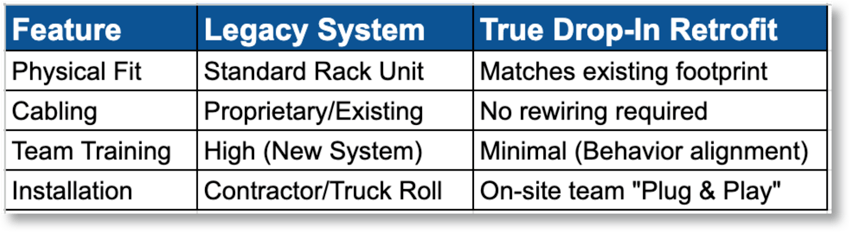
A drop-in retrofit is engineered so it can slot into the place of the legacy unit with minimal disruption for satellite communication systems. Practically, that means:
- It fits the existing footprint (rack, power, cooling expectations).
- It aligns to the interfaces your operations already depend on.
- It’s designed to behave in familiar ways so you’re not re-teaching the team how to interpret the system during a high-stakes moment.
And yes, the point is simplicity. Your on-site team can often handle the swap themselves. No waiting on specialized installers. No outside contractor dependency. No extended truck roll just to get back to baseline.
“Made by the same people” is not a throwaway detail
Drop-in claims only matter if you can trust the engineering behind them.
A major reason retrofit approaches work is continuity. The replacement is engineered by the same team that understands the original legacy specifications, not just generally, but in the small details that affect day-to-day operations. That institutional knowledge is what bridges the gap between “it should be compatible” and “it behaves the way teleport teams expect.”
For teleporter managers, that’s a high-trust signal. Fewer unknowns, fewer surprises, and a smoother path through validation.
Why this matters for end-of-life (EOL) reality
A lot of teleport teams aren’t ignoring EOL gear. They’re stuck with it.
Without a drop-in retrofit option, the alternative is often a full rip-and-replace. That means new workflows, new integration work, new training, and new failure modes introduced all at once. That level of change can feel riskier than staying on aging equipment.
Retrofit simplicity is what makes EOL replacement practical. It lowers the operational barrier enough that teams can move forward without taking on a full-scale transformation.
Why timing matters right now
We are hearing from incoming customers that there are six to nine month lead times for SATCOM control equipment replacements right now. These timeframes are becoming standard across the industry due to supply constraints affecting screens and other critical components.
For teams already managing aging gear that’s reached end-of-life, that kind of delay isn’t just inconvenient. It’s a risk multiplier. When a critical unit finally fails, a nine-month lead time stops being a planning problem and becomes an operational crisis.
Radeus Labs is currently maintaining approximately 60 - 90-day lead times on the 8200 Legacy series, depending on configuration, the drop-in retrofit solution designed specifically to replace aging 7200 systems. For teams evaluating the Radeus Labs 8200 ACS, that creates a real window to move off EOL gear without waiting through extended backlogs.
This isn’t about rushing a decision. It’s about having options when the timing works for your operation, rather than being forced into reactive mode when legacy equipment reaches a breaking point and replacement options are months out.
What makes a “true” drop-in retrofit solution
Not everything labeled “drop-in” delivers the same experience. If you’re evaluating options, look for a solution that holds up on four fundamentals:
- Form-factor compatibility, it fits where the old unit lived.
- Interface parity, control ports, alarms, telemetry, and comms match expectations.
- Behavior alignment, commands and cues work in ways your team recognizes.
- Support continuity, documentation and support are built for mission-critical ops.
This is the difference between “we can make it work” and “we can swap it with confidence.”
For teams managing satellite antennas and controllers, these details are not secondary. The replacement must support the realities of the existing antenna environment, including control behavior, operator expectations, and long-term support needs.
Planning a retrofit without disrupting operations
Even with a drop-in approach, the best outcomes come from light planning:
- Audit interfaces and dependencies (what talks to what, and how).
- Choose a realistic test window aligned to service obligations.
- Validate behavior in your normal workflow before calling it done.
The goal is simple. Continuity with reduced risk.
A strong retrofit path should make the antenna control system feel familiar where it matters, while renewing the internal capability needed to keep the site supportable.
Meet the team at SATELLITE 2026 (Washington, D.C.), Booth #2736
These are exactly the kinds of operational conversations happening across the teleport community, how to reduce EOL risk, modernize carefully, and avoid turning a replacement into a multi-month disruption.
If you’re attending SATELLITE 2026 in Washington, D.C., March 23–25, 2026, you can meet the Radeus Labs team at Booth #2736, or schedule a meeting, to talk through retrofit paths, drop-in replacement realities, and what a low-disruption swap can look like in your environment.


 Over the past few weeks, the Radeus Labs team has been on the road connecting with customers, partners, and new industry contacts. Computing and Recording Specialist Clay Moore attended