

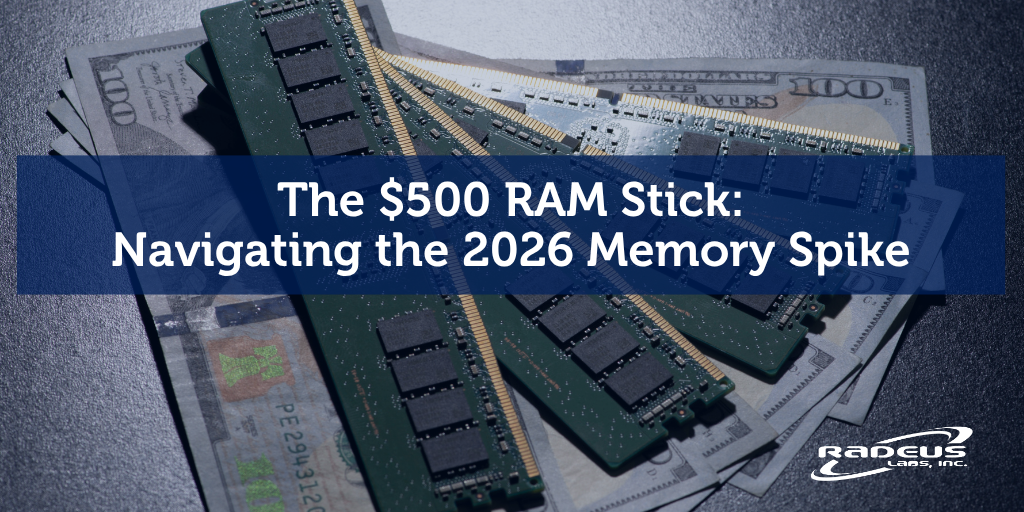
If your systems rely on compute, storage, or embedded hardware, the numbers have already changed under you. RAM that cost $32 a stick last August is now $500. SSDs that were $125 are tracking at the same steep increase. A server that sold for $50,000 six months ago now costs $70,000. And by the end of this month, prices on key components are expected to double again.
This is not a typical cycle. It reflects a structural reallocation of how memory and silicon are produced and who gets access to it.
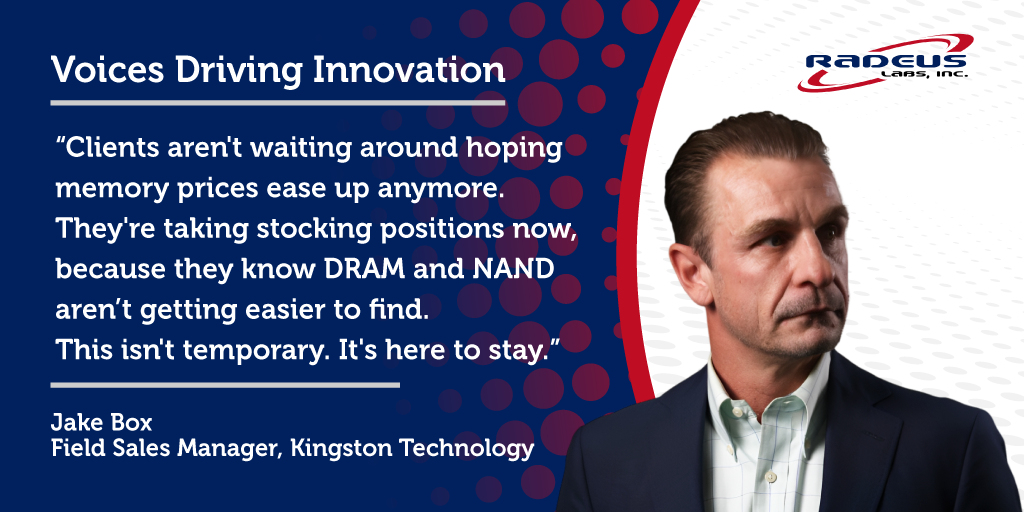
As our CEO Juliet Correnti put it: "This is a wild time in the market, and there are serious impacts from it. The goal is not to create panic. It is to understand what is happening and offer our customers a clear way to navigate it."
The question is not whether the volatility in the memory market affects your environment. It is how exposed you are. And the best way to answer that is to break your systems down into tiers of volatility.
Why the Market Is Moving
Several forces are converging in ways the industry has not seen before:
- AI is consuming chip capacity. The largest AI companies are cornering wafer capacity ahead of everyone else. Major fabricators have reallocated roughly 75% of their capacity toward high-bandwidth memory for AI infrastructure, leaving 25% for standard DDR4 and DDR5 modules.
- The pressure extends well beyond RAM. SSDs, NAND flash, processors, motherboards, and add-in cards like GPUs and RAID controllers are all seeing reduced availability as upstream silicon gets diverted.
- Manufacturers are not expanding capacity. New fabrication facilities require multi-billion-dollar, decade-long investments. Chipmakers have been burned by overbuilding in previous cycles and have stated publicly they will not do it again.
The result is a market where demand is surging, supply is constrained by design, and there is no near-term correction on the horizon. Correnti, who has been in the industry for 16 years, checked this read with colleagues who have 25 to 40 years of experience. Their response was the same: the speed at which pricing is moving has no parallel in their careers.
For organizations planning advanced computing solutions, this is no longer just a procurement issue. It affects architecture decisions, lifecycle planning, customer commitments, and whether systems can be built when they are needed.
The Tier Framework: Understanding Where Your Risk Lives
When Radeus Labs needed to help a customer understand their true exposure, the answer was not a blanket price increase. It was a framework: breaking down every component in a system by its level of market volatility.
That analysis revealed something critical. A system might have 50 components, but only a fraction of them are driving the majority of cost risk and availability concern.
Tier One: Highly Volatile
This is where the crisis is concentrated. RAM and SSDs are directly tied to the supply constraints reshaping the market, seeing the most extreme price movement and the most limited availability.
These two component types historically tracked against different market indices and moved independently. Today they follow nearly identical pricing. When RAM quotes come in at $395, SSDs come in at $398. When RAM hits $500, SSDs hit $500. Nobody in the supply chain has explained this convergence.
Samsung, one of the largest memory manufacturers in the world, has announced price increases of over 100% effective this month, while simultaneously having canceled orders and holding essentially zero available stock. Industry analysts confirm that global RAM allocation for all of 2026 is already 95% or more committed.
In a real-world system analysis, a server with roughly 50 components had 25 Tier One parts (nine SSDs and 16 sticks of RAM). Those 25 parts drove the overwhelming majority of both cost and risk. This tier is on spot pricing and moves daily. Distributors cannot place speculative orders. Manufacturers like Kingston are accepting orders into a queue with no confirmed price and no confirmed delivery date. You are either in line with a valid order, or you are not in line at all.
For teams buying AI server ram, this creates an immediate planning problem. Pricing can shift before internal approvals are complete, and availability may depend on committed demand rather than projected need.
Tier Two: Broadly Impacted
These parts depend on the same underlying silicon or manufacturing capacity as Tier One but are not yet seeing the same extremes. Processors, motherboards, and certain add-in cards fall here. Increases are trending around 25% and becoming less predictable. The risk is compounding: if you are already managing Tier One volatility, Tier Two increases can push total system cost into territory that breaks budgets or stalls programs.
Tier Three: Relatively Stable
Components less dependent on constrained supply chains, at least for now. Not the immediate priority, but worth monitoring. In previous cycles, stability in one tier has sometimes been a lagging indicator rather than a permanent condition.
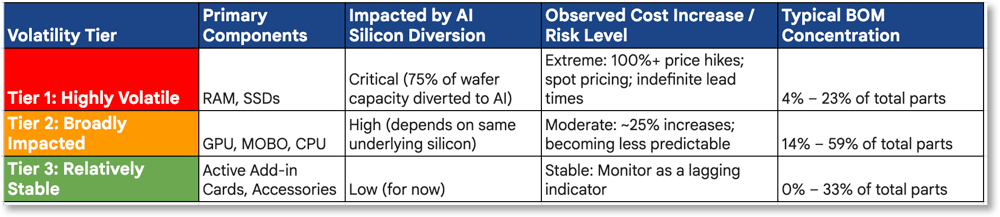
A system may have 40–50 components, but as little as 10 components can drive up to 80%+ of total cost volatility and supply risk
What the Tiers Reveal
In some configurations, 84% or more of the bill of materials is exposed to Tier One and Tier Two volatility. That means the entire build is at risk, even if most individual parts seem routine in isolation. Meanwhile, manufacturers are quietly consolidating SKUs, and parts are effectively disappearing without formal end-of-life notices. If you are waiting for official EOL paperwork before acting, the part may simply be gone first.
As Correnti described: "You have to look at your systems differently right now. Break them down, understand where the volatility is, and take action on those pieces first."
How Quickly This Has Escalated
In January 2026, this situation warranted formal customer notification by our team. By March, just two months later:
- Global RAM allocation for all of 2026 was 95%+ committed
- Samsung's 100%+ price increase was official
- Lead times for unforecasted RAM and SSDs moved from "extended" to effectively indefinite
- The window to lock in earlier pricing was closing within days, not months
For organizations still on quarterly procurement cycles, that pace of deterioration is a serious problem.
What You Can Do Now
- Analyze your BOM by volatility tier. Identify where exposure is concentrated. A system with 50 parts might have only 10 driving 80% of cost risk. Those demand immediate attention.
- Secure Tier One components now. If RAM and SSDs determine whether a system ships, lock those in first. Lead times are indefinite and pricing resets weekly.
- Forecast further out than usual. Suppliers are requiring committed demand before assigning allocation. A real purchase order puts you in the queue. Without one, you are not in line at all.
- Identify alternatives early, but be realistic. The two-terabyte SSD you need may only have two or three qualified options, and those may already be constrained or heading toward obsolescence.
- Align internal teams around shared risk. Engineering, procurement, program management, and finance need the same picture. The companies navigating this are the ones having these conversations proactively.
A Shift Toward Proactive System Planning
Global chip capacity is being redirected toward AI, reducing what is available for everyone else. Manufacturers are not expanding supply, and competitive pressure is only accelerating.
The organizations navigating this successfully are the ones that broke their systems down, understood which components carried real risk, and acted on those tiers first. The window to plan around this is still open, but it is narrowing fast.
For mission-critical computing teams, the lesson is clear: component planning cannot wait until the system is ready to build. It has to happen earlier, with sharper visibility into which parts carry the greatest pricing and availability risk.
If your team wants to evaluate your specific exposure, reach out to Radeus Labs for a conversation with our engineering team.