

When Troy Wood, one of the Senior Engineers at Radeus Labs, hears that a system has been broken for months, his first instinct is not frustration. It’s curiosity.
He wants to know what assumptions were made, what was tried, and where the real constraints live. Somewhere in that space, he’s confident the answer is waiting. That instinct has defined Troy’s career and helped shape Radeus Labs from its earliest days.
Long before rugged systems, defense programs, or virtualization strategies, Troy was drawn to one simple idea: if you understand how the pieces fit together, you can usually find a way forward.
A Curiosity That Showed Up Early
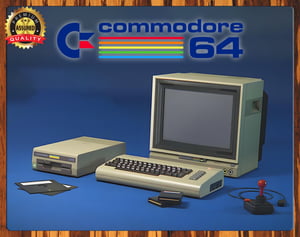 Troy’s first program ran on a Commodore 64. It was simple. A character breakdanced when you pressed keys.
What mattered was not the output, but the impulse behind it. Give Troy a machine and he immediately wants to see what it can do, where it breaks, and how far it can be pushed.
That curiosity followed him through school, into Linux, and into early networking projects at a time when IT was expensive and rarely documented. If something needed to work and no one had a playbook, Troy figured it out. That habit never left.
Where Radeus Really Started
Before Radeus Labs existed, Troy was working at a small audio-video supply shop in Southern California, configuring specialized systems for live broadcast and nonlinear editing. At the time, video on a computer was not a given. It required precise combinations of hardware and software that rarely worked out of the box.
One day, a General Atomics engineer arrived with a computer that had been giving another vendor trouble for more than six months. The request was straightforward on paper: ingest video, capture still frames, and associate them with GIS data.
The system didn’t work. Troy made a few targeted changes, removed what didn’t matter, adjusted what did, and suddenly the problem disappeared.
That moment set something in motion.
Troy and Ray Hayden began supporting General Atomics while still at the shop. When the shop’s owners decided they didn’t want to grow the government side of the business, Troy and Ray split off. In 2003, they started what would become Radeus Labs.
Building Through the Uncertain Years
The early days were not polished.
Government contracts move slowly. Startups don’t. While waiting for work to clear, Troy and the team did what was necessary to keep the business alive. They wrote specialized software for unrelated industries. They took on general work. They filled gaps wherever they could.
By 2007, Radeus Labs was officially incorporated. More importantly, it had earned trust. Engineers didn’t just buy systems from Radeus. They leaned on the team to solve problems, test ideas, and support programs over the long term.
That relationship-first mindset became a defining trait.
Customization Without the Bloat
When Troy talks about custom computing, he’s careful to separate signal from noise.
Customization is not about maximizing specs. It’s about understanding the real production need. Developers often build software on oversized systems because flexibility matters during development. Problems arise when those same systems are pushed into production, only to be retired by OEMs a year later.
Radeus takes a different approach.
Troy and his colleagues design systems that are right-sized for production, built for longevity, and sustainable over years. The goal is not peak performance on day one. It’s continuity. Availability. Programs that don’t collapse when a SKU disappears.
That perspective reduces cost, minimizes risk, and keeps customers out of redesign cycles they never planned for.
Architecture Is a Team Sport
Ask Troy about his role today and he’ll call himself an architect.
At Radeus, that means understanding how everything fits together and being able to step in wherever needed. Troy has designed PCBs, written embedded software, modeled enclosures, and worried about production details most people only notice when something fails.
 But he doesn’t do it alone.
Troy works closely with fellow senior engineer Andrew Correnti and Don Hughes, who share leadership responsibilities across the engineering department. Without a formal engineering manager, the group operates collaboratively, stepping in where needed and covering for one another as priorities shift.
That structure matters. When Troy is pulled deep into a complex project, the department doesn’t stall. The team adapts. Knowledge is shared. Progress continues.
It’s a model that reflects how Troy thinks about systems in general: resilience comes from thoughtful design, not single points of failure.
Turning Experience Into Growth
As Radeus has grown, mentoring has become a bigger part of Troy’s work. Junior engineers are coming up fast, and part of his role is helping them develop judgment, not just technical skill.
.jpg?width=800&height=360&name=20220815_160518%20(1).jpg)
Some things can be documented. Some can’t. Experience still matters.
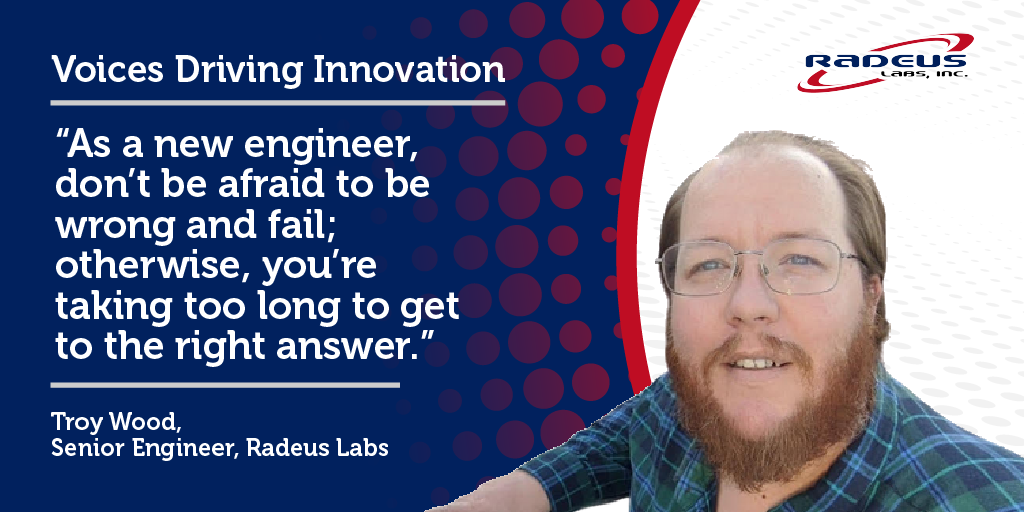
If Troy could give every new engineer one piece of advice, it would be this: don’t be afraid to fail.
Young engineers often feel pressure to get everything right the first time. They circle problems, double-check endlessly, and avoid being wrong. Troy sees that as a trap.
Experimentation gets you to real answers faster. Failure teaches. Waiting too long for perfection can be more damaging than trying, learning, and adjusting. In business, speed and learning matter more than being right on the first try.
That belief sits at the core of how Troy builds, mentors, and leads.
Still Leaning In
Today, Troy spends a lot of time helping organizations move beyond traditional one-to-one computing models. Virtualization, in his view, isn’t about trends. It’s about simplifying complexity, reducing risk, and building systems that last.
But at the core, his approach hasn’t changed.
When a problem feels entrenched, Troy doesn’t step back. He leans in. He listens carefully. He questions assumptions. And more often than not, he finds the place where things can finally move.
That instinct has shaped his career, strengthened his teams, and helped define Radeus Labs from the very beginning.
And it’s the same instinct he still brings to work every day.
Where Is the Radeus Team Next?
 If you’re attending SATELLITE 2026 in Washington, D.C., March 23–25, 2026, you can meet the Radeus Labs team at Booth #2736, or schedule a meeting, to discuss system longevity, obsolescence mitigation, and realistic replacement strategies for mission-critical SATCOM and compute platforms.

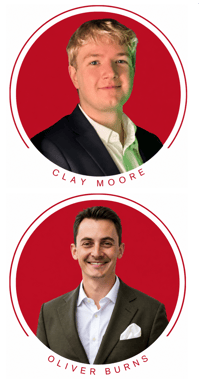 Over the past few weeks, the Radeus Labs team has been on the road connecting with customers, partners, and new industry contacts. Computing and Recording Specialist Clay Moore attended