

You open an email on a Tuesday morning and learn that a product your system depends on is being discontinued. Maybe the vendor got acquired. Maybe the platform hit end of life. Maybe the company pivoted and your use case no longer fits their roadmap.
The instinct for a lot of organizations is to find the nearest replacement, drop it in, and get back to normal as fast as possible. That instinct is understandable. It is also how programs end up selecting a replacement based on what they used to have rather than what they actually need."
A forced transition is disruptive, but it is also one of the rare moments where a program has both the reason and the leverage to question assumptions that normally go unchallenged.
The Recommended Replacement May Not Be Your Replacement
When a product gets discontinued, there is often a vendor-recommended migration path. Sometimes it works. Sometimes it does not
Consider what happened with the Stratodesk NoTouch OS. For years, NoTouch served as a reliable, purpose-built thin client operating system for endpoint access in mission-critical environments. Then the vendor was acquired by IGEL, who retired NoTouch and directed everyone to their platform.
On paper, the replacement was functionally similar. In practice, the IGEL operating system required a persistent cloud connection for licensing and management. For air-gapped environments with no cloud access, which described our customers using the NoTouch, the recommended replacement was completely unusable.
The vendor's migration path led to a dead end. The actual path forward required stepping back and evaluating the problem from scratch. This pattern repeats constantly. The recommended replacement assumes conditions that may not match your environment, your security posture, or your operational constraints.
For teams facing an EOL replacement, that mismatch can create more risk than the discontinued product itself.
Start With Requirements, Not Feature Lists
When a forced transition hits, the temptation is to pull up the old spec sheet and compare features line by line. This feels rigorous. It is often the opposite.
Spec sheets accumulate. Requirements from five or ten years ago persist in documentation long after the operational need behind them has disappeared. Features that were critical under a previous architecture may be irrelevant under the current one. But because they appear on a checklist, every candidate gets measured against them. Suitable alternatives get discarded because they lack a feature nobody uses.
As recently as 2012, a major defense contractor was still requiring floppy disk drives in computer procurements because that is what the previous system had, and the one before that. Requirements persist long after the rationale behind them is gone.
A forced transition is one of the few moments where honest reassessment is not only possible but expected. The question that rarely gets asked during normal operations becomes essential: do we still actually need this?
That is where legacy replacement planning has to move beyond matching old specifications and focus instead on current system behavior, security requirements, lifecycle realities, and operational constraints.
You Are Probably Not the First
One of the more common mistakes during a forced transition is assuming the situation is unique. It rarely is.
When a widely used product gets discontinued, migration tools get built, compatibility layers get developed, and vendors competing for the displaced user base invest in reducing switching friction. Before committing engineering hours to a custom migration path, search for existing tools and documented approaches. Someone has likely built a bridge. Find it before you build your own.
Then widen the search. The competitive landscape may look very different than it did when the original product was selected.
New platforms may have matured. Licensing models may have shifted. A structured trade study across available alternatives is the difference between landing on a platform that serves the program for the next decade and landing on one that creates the same problem again in three years.
Test Before You Commit, Then Update Everything
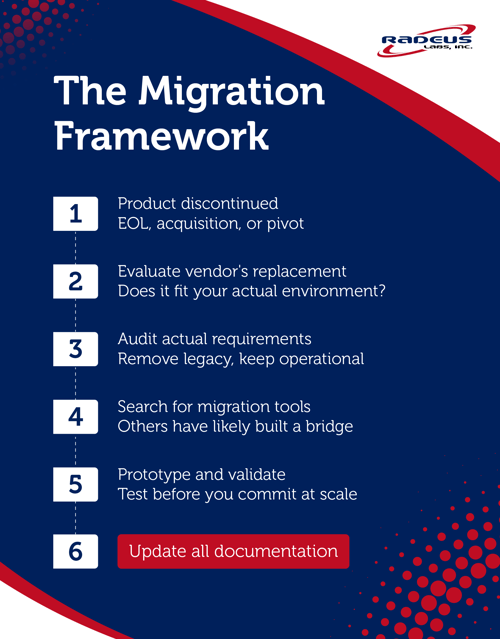
Schedule pressure has a way of turning evaluation into procurement before testing has occurred. If the replacement is software, build a sandboxed environment and exercise it under realistic conditions. If it is hardware, get a unit in and validate it against actual workloads before placing a production order.
The cost of a prototype is trivial compared to discovering a compatibility issue after hundreds of units have shipped.
For organizations responsible for mission-critical computing, validation cannot be treated as a formality. The replacement has to perform inside the real operating environment, with the actual workload, constraints, security posture, and support expectations that define the system.
And once the transition is complete, update every document that references the old product. System architecture descriptions, interface control documents, test procedures, training materials, support contracts. This is not administrative overhead. It is the difference between a clean transition and years of confusion when sustainment teams encounter references to a product that no longer exists in the system.
This Will Happen Again
Forced transitions are not anomalies. They are a predictable feature of long-lifecycle programs operating in markets with short product cycles. Vendors get acquired. Platforms get retired. Licensing models change overnight. The question is never whether a discontinuation will affect your program. The question is whether your program is structured to absorb it without starting from zero every time.
How Radeus Labs Supports These Transitions
At Radeus Labs, we work with defense, aerospace, and mission-critical programs that face these transitions regularly. Our role is to reduce the effort, time, and risk involved in getting from a discontinued product to a validated replacement.
That starts with requirements review and carries through to a validated replacement:
- Requirements audit. We ask the straightforward questions that tend to go unasked once a product has been in service for years. Why is that a requirement? Is that a feature you actually use? What are you actually trying to accomplish?
- Alternative research. We evaluate viable replacements against your real environment and constraints, not legacy spec sheets, and present the pros and cons of each.
- Prototyping and validation. We help you get evaluation hardware or software in place so you can test before you commit at scale.
For teams evaluating advanced computing solutions, this process helps prevent a discontinued component from becoming a rushed procurement decision, a compatibility problem, or another unsupported system in the near future.
If your program is facing a forced transition and you want to talk through the options, reach out to our engineering team. We have been through this process many times, and we would rather help you navigate it well than watch you navigate it twice.