

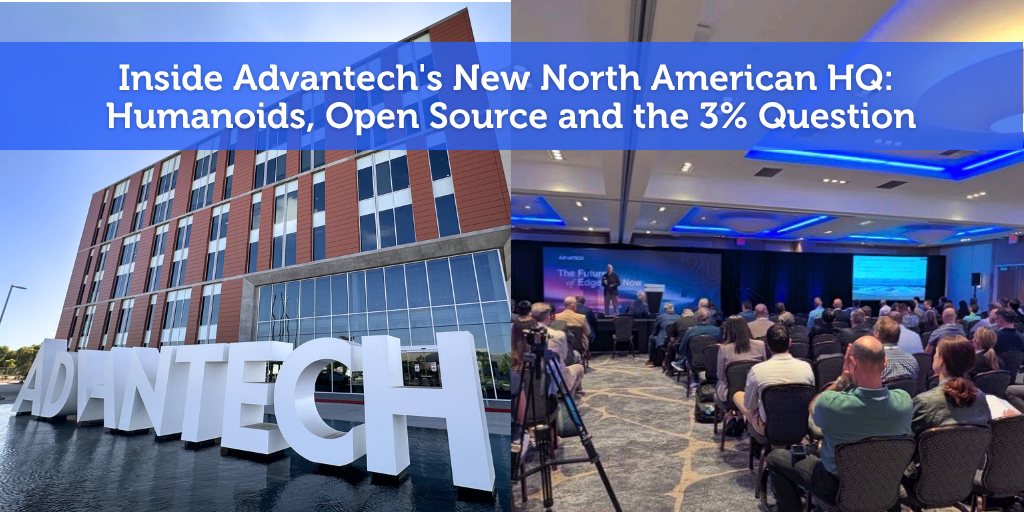

In October, I spent two days with Advantech as the company opened its new North American headquarters in Tustin, California. The visit included an open house, followed by the
Advantech Technology Summit in Newport Beach, which brought together AMD, Intel, NVIDIA, and Qualcomm.
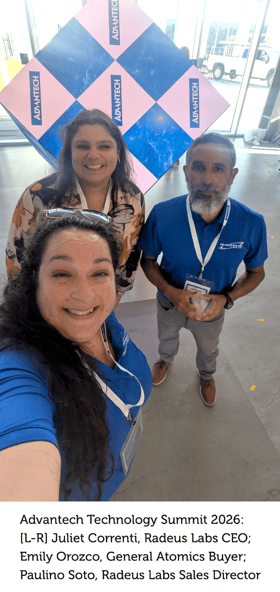 It was my third manufacturer industry day this year, following Kingston’s Integrator Summit and an Ingram Micro event for system integrators. The previous events each drew about 40 people; Advantech’s grand opening made this one much larger. Our new Sales Director, Paulino Soto, joined me.
A highlight was catching up in person with Emily Orozco, a buyer at General Atomics.
I go to these events to hear from the people who build the components inside our systems, before changes show up in our customers' lead times.
A Showroom That Covered Everything
 Instead of a building tour, we were escorted around Advantech's showroom, which covered their full range from defense hardware to medical systems, including a patient mannequin that had just given birth.
Advantech is a good vendor for us. They build a lot of products and design for longevity, which matters for programs that run for decades.
They're also agnostic, with Intel, AMD, NVIDIA and Qualcomm all in the room. The larger event format had its trade-offs, though. With competing manufacturers sharing the stage, the presentations stayed fairly high-level. I found the smaller breakout sessions and individual conversations much more useful.
Everyone Is Talking About Humanoids
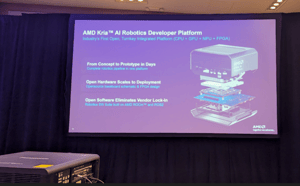 The opening talks kept coming back to humanoid robots; I heard about half a day of it. The pitch is scale: one in every home, one for every person.
I'm not convinced that's the AI people want. Our customers ask for practical help: taking on repetitive tasks, supporting decisions and keeping costs down. A humanoid feels like an expensive answer to a question few are asking. (I also find them a little creepy.)
It's a market worth watching, but for mission-critical teams the near-term value is in low-cost, helpful solutions.
Open Source Is Gaining Ground
The more encouraging theme was open source, including open source developer kits. I believe that's where the industry is heading.
AI is making it easier to develop software, including alternatives to proprietary tools. That could make it harder for vendors to rely on closed ecosystems and recurring licensing fees the way they have in the past. That's why some call AI a "SaaS killer," and as someone who's never liked paying forever for software as a service, I hope they're right.
CUDA is a good example. Building for NVIDIA GPUs has long meant programming in CUDA, which kept developers captive. That's becoming a moot point, and vendors know they can't count on lock-in forever. We've seen the same shift in our own move from VMware to Proxmox.
The 3% Question
This is the takeaway I keep coming back to: Advantech showed the military as only about 3% of its market.
I don't think that tells the whole story, and Paulino and I have talked it over since. Military demand flows through integrators, distributors and other entities, so manufacturers often don't know where their products ultimately end up. Even when we sell to customers outside the defense industry, that equipment frequently ends up supporting military programs.
That isn't just a reporting problem. When manufacturers think defense represents a tiny slice of their business, it affects how much attention we get, how they allocate scarce products, and how seriously they take our requirements. We end up having to fight harder for equipment that may ultimately support some of the most important programs in the country.
When I raised the issue, the response was that the company was still developing a clearer view of end-user demand.
It matters for allocation too. Under the Defense Priorities and Allocations System (DPAS), rated defense orders can take priority, and in this market we've been able to "flash our DPAS card" and actually get product. Some suppliers honor it readily; others stay focused on hyperscalers, even though much of that capacity serves defense too.
The good news is that more suppliers now require proof of who the end user is: to prevent stockpiling, because advanced GPUs can't be sold to countries like China, and for security.
GPUs are now valuable enough to attract organized theft. In one recent case, $11.4 million in NVIDIA hardware vanished in a California cargo heist after a truck posing as a food carrier picked it up in Oakland.
As more manufacturers ask who's ultimately using their products, perhaps they'll start getting a clearer picture of just how much of their business supports defense.
Why Direct Relationships Matter
That's why I value direct manufacturer relationships. Even a company much larger than ours doesn't have every detail polished. Advantech's website doesn't always show what they offer, so our engineers rely on direct contact.
A breakout session also gave me a direct contact at AMD, which we value. I've been impressed by how customer-focused AMD has become since acquiring Xilinx, and by its APUs, which put a CPU and GPU on one chip. More on that in a future post.
I can read industry predictions all day long, but there's no substitute for talking directly to the people making the products. Sometimes they confirm what we've been thinking. Sometimes I learn something I didn't expect. Either way, those conversations are worth having. I'll keep showing up.
If you're trying to make sense of where the market is heading, or how it affects your next build, schedule a call with our Sales Director Joe Romano. We would love to help.
—Juliet Correnti is the CEO of Radeus Labs, a U.S.-based cleared facility and ISO 9001 certified manufacturer of satellite communication and computing systems for military, infrastructure, aerospace, government technology solutions, and public safety environments.
 In satcom, every satellite pass, flight test, and range operation produces a flood of data that teams must acquire, protect, and turn into insight. That challenge surfaced repeatedly at the