

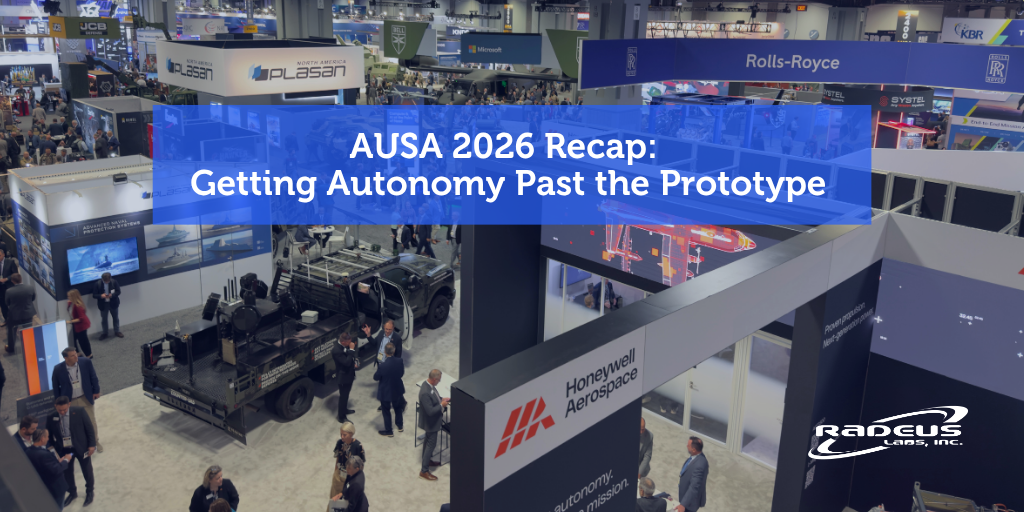

Autonomy was impossible to miss at last week’s AUSA Annual Meeting & Exposition in Washington, D.C. Radeus Labs’ new Sales Director, Paulino Soto, and Computing Account Executive Clay Moore were among the attendees as the Army signaled that autonomous systems are moving from experimentation to fleet deployment, fast.
The show was one of Paulino’s first since joining Radeus Labs, and a chance to reconnect with familiar faces across the defense community and introduce them to his new team.
For Clay, the show made one thing clear. “Everywhere you turned, someone was showing a platform that could operate on its own,” he said. “The bigger question for us is what it takes to get that computing onto real vehicles and keep it running for the life of a program.”
A Show Floor That Never Slowed Down
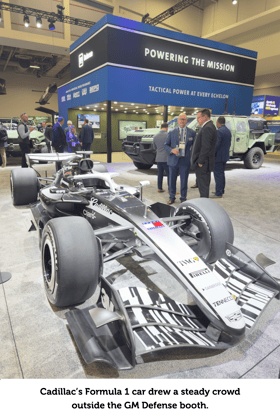
Tens of thousands of attendees filled the halls, and demand for face time was so high that many teams booked meetings in nearby buildings.
Clay met with Leidos and the Missile Defense Agency’s small-business team to learn more about how major contracts reserve work for small businesses. Paulino connected with Lockheed Martin’s aviation team, where autonomous helicopters and other platforms underscored how quickly autonomy is becoming part of the defense landscape.
“Everybody is moving into unmanned vehicles,” Paulino said. “Autonomy is the big push, and it’s all AI-driven.”
The Army’s Autonomy Push
The Army backed the autonomy on display with deadlines. An October 1 memo from Acting Secretary of the Army Adam Telle directs autonomy into at least six types of formations (from aviation and armor to sustainment and training) with initial capabilities fielded by fiscal year 2028.
 At the show, Gen. Christopher LaNeve, the Army’s vice chief of staff and acting chief of staff, announced that Futures and Concepts Command is now Futures and Autonomous Systems Command. The Army also outlined experiments across all five corps and named Fort Rucker its UAS Autonomy Center of Excellence.
Telle used the opening AUSA ceremony to announce a Manufacturing Rodeo for early 2027: a competitive stress test of the industrial base intended to reveal where production capacity and supply chains may fail under pressure.
For companies developing autonomous systems, the message is clear. A 2028 fielding timeline compresses the work of proving a platform, integrating its compute stack, and creating a repeatable production baseline that can be sustained over years.
Getting Autonomy Past the Prototype
Most autonomous systems are built in two stages: first, prove that the platform can perform the mission; then, establish a production baseline that later systems must match closely enough for the original testing to remain valid.
The Army’s timeline puts pressure on both stages, and the computers inside those systems will feel it first.
- Processing moves onto the platform. Sensors produce data faster than a contested tactical link can carry it, so computing moves closer to the sensor.
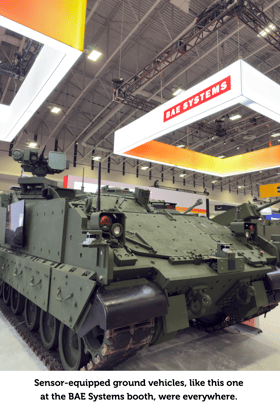
Ahead of the show, Maris-Tech announced plans to demonstrate onboard edge video and AI for armored vehicles and unmanned platforms. That places power draw, heat, vibration, and environmental demands on vehicles that already have limited budgets for all of them.
Edge computing also supports resilience when communications are jammed, degraded, or unavailable, and in GPS-denied environments. The goal is not simply to process more data onboard, but to give a vehicle, aircraft, or vessel enough local capability to continue sensing, analyzing, and acting when it cannot rely on a continuous connection to outside systems. - Integration runs through the software. A computer added late must match the existing operating system, camera and accelerator drivers, time synchronization, and middleware. Testing early with the actual sensors and autonomy software catches mismatches while changes are still manageable.
That integration work is especially important for long-lived and legacy programs. New GPUs, sensors, and AI software can add capability, but they still must fit an established power envelope, physical environment, and validated hardware and software baseline. - Validated configurations have to stay buildable. The Rodeo’s premise applies to electronics, too: production pressure reveals weak links. Boards get revised, processors reach end of life, and a new accelerator or driver can shift inference timing on validated software. Recording everything from the bill of materials to BIOS settings, firmware, drivers, and the operating-system image helps ensure that later builds match the configuration that was tested.
When a change is unavoidable, it should be treated as a controlled revision (not an informal replacement) with a documented delta, retest plan, approval path, and record of the resulting performance.
Where Radeus Labs Fits
Radeus Labs designs and builds custom, rugged AI servers, workstations, and high-density, low-power servers. We work with integrators and OEM engineers on configuration from day one, then provide configuration management, legacy-system replacement, and U.S.-based engineering support across the lifecycle.
Our 25-year partnership with General Atomics Aeronautical on unmanned-aircraft ground-control stations shows what lifecycle support can look like in practice.
For Clay, AUSA reinforced how tightly these requirements fit together. “Autonomy, edge compute, power, legacy integration, they’re all connected,” he said. “That’s the conversation we want to be part of.”
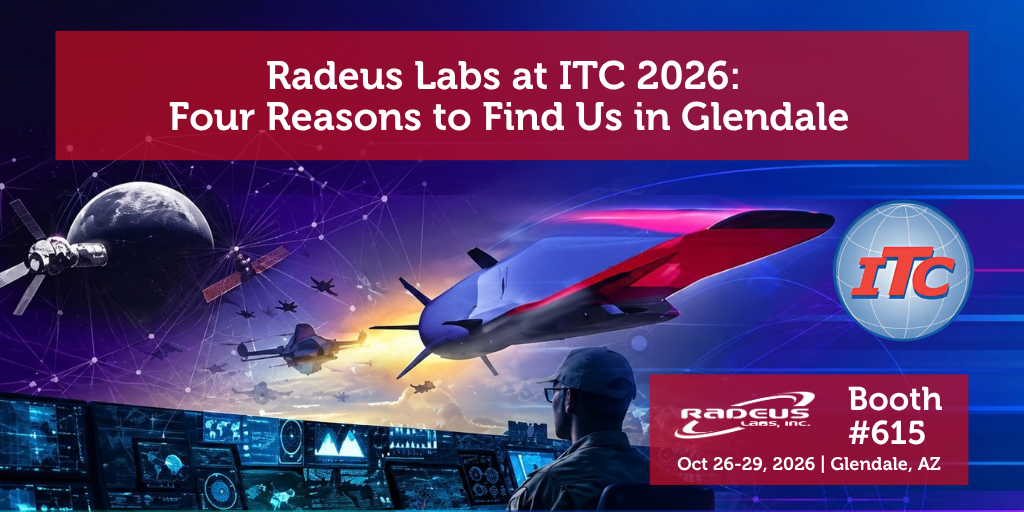
Next Up: Meet Radeus Labs at ITC 2026, Booth #615
From October 27 to 29, find Radeus Labs at Booth #615 at the International Telemetering Conference (ITC 2026) in Glendale, Arizona. ITC brings together the telemetry community around the systems, data, infrastructure, and people that support demanding test and mission environments.
At Booth #615, meet CEO Juliet Correnti, Senior System Architect Andrew Correnti, Clay Moore, and SATCOM Account Manager Oliver Burns. The team will be showcasing Radeus Labs thin clients, servers, and antenna control systems built to support LEO, MEO, and GEO operations under real-world conditions, backed by U.S.-based engineering support.
Here is where you can find the Radeus Labs team during the show:
- Tuesday, October 27, 12:00–1:00 p.m.: Juliet joins leaders from the Test Resource Management Center and Curtiss-Wright Defense Solutions for the panel, “Building the Next Generation Telemetry Workforce.”
- Thursday, October 29, 11:00 a.m.–12:00 p.m.: Andrew presents, “The Subject-Matter Expert as Developer: AI-Assisted Tooling for High-Volume Telemetry Data.”
- ITC Talent Connect Hub, Media Center: Students and early-career engineers can meet the Radeus Labs team Tuesday from 10:30 a.m.–12:00 p.m. and Wednesday from 11:00 a.m.–12:00 p.m.
Stop by Booth #615 to connect with the team, explore Radeus Labs computing and antenna-control systems, and enter the LEGO® drawing. You can also schedule a meeting to meet the team at ITC 2026 →

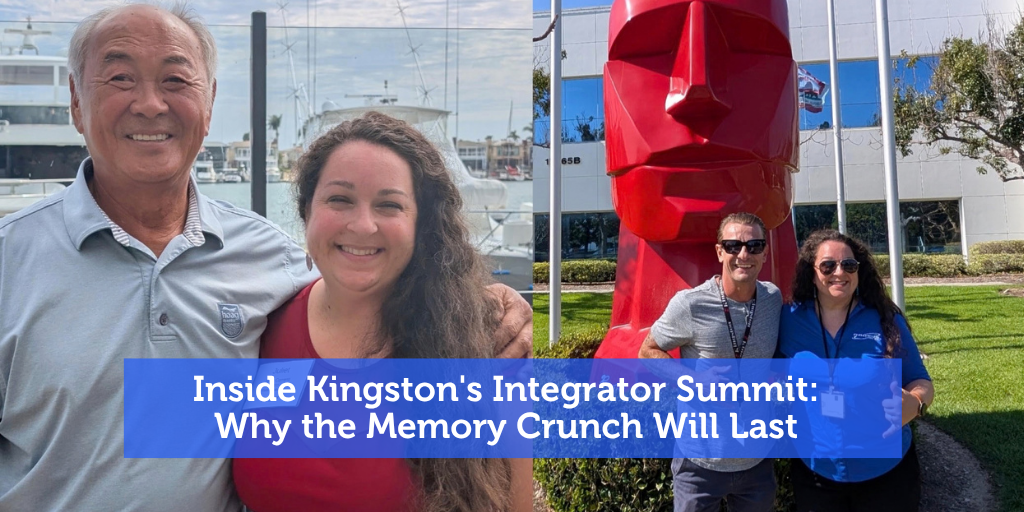
 This summer I spent two days at Kingston Technology’s Integrator Summit. It was a small group: about 15 companies, capped at 40 people. We heard their market outlook, walked through product roadmaps, met one-on-one with our Kingston account reps, and met David Sun, one of the founders.