

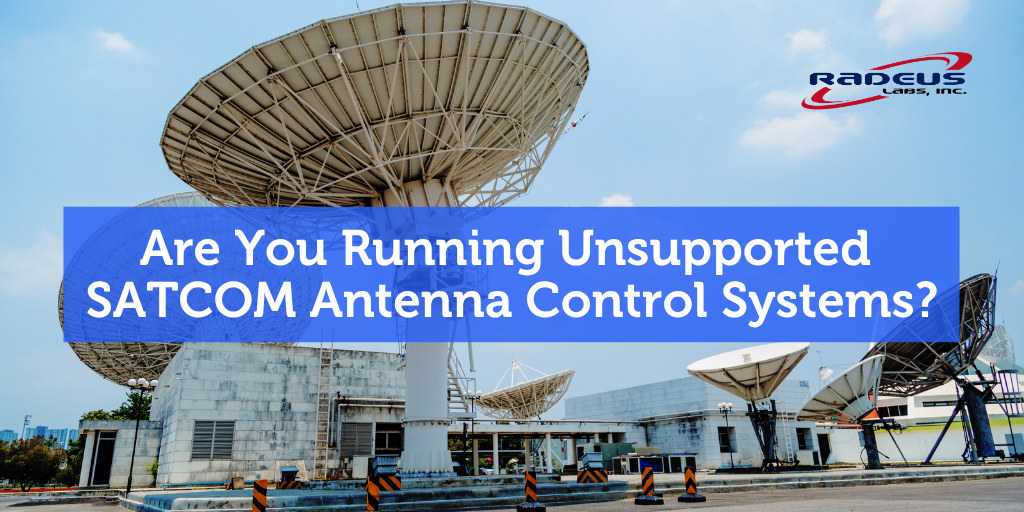
In many teleport environments, control systems stay in place for years without issue. If they are working, they are left alone. That is true across a wide range of satellite control systems, especially in established sites where infrastructure has been stable for a long time.
That is where many 7200-series antenna control systems are today. They are still running. There are no active issues. Day-to-day operations continue as expected. But those systems are now 15–20 years old, classified as end-of-life equipment, and are no longer supported. There is no ongoing manufacturer support. No long-term guarantee of parts. No clear path for service continuity.
End-of-life is already here. Most teams just have not been told.
In recent conversations with teleport operators, this has come as new information, even to experienced teams who have been working with these systems for years. Many are not aware that their system is unsupported, that replacement options exist today, or that they are already operating outside of a supported lifecycle.
That creates a quiet risk. Systems continue to run, but without a defined recovery path when something fails.
End-of-life does not stop operations. It removes your margin for error.
Running unsupported infrastructure does not immediately create downtime. That is part of what makes it easy to overlook.
The issue is what happens when something changes.
- A component fails and cannot be sourced
- A subsystem requires maintenance that no longer exists
- A site expansion requires integration with unsupported systems
- A failure introduces delays that cannot be recovered quickly
At that point, the problem is no longer technical. It becomes operational.
The difference between a managed upgrade and a forced replacement is usually timing.
Replacement has historically meant disruption. That assumption is outdated.
One reason many sites delay action is the expectation that replacement requires:
- system redesign
- extended downtime
- engineering involvement on-site
- retraining and revalidation
That has been true for many traditional upgrade paths. But it is not universally true anymore.
The current generation of retrofit systems is designed to remove most of that friction. In the case of the Radeus Labs 8200 antenna control unit, the replacement model is intentionally simple. The unit can be shipped, installed in place of the legacy system, and brought online without a full system overhaul of surrounding tracking antenna systems.
That changes the decision from a project to a planning exercise.
Timing is becoming a constraint, not just a consideration
There is a second factor that is less visible but increasingly relevant: lead times.
In recent field conversations, operators have noted extended delays for comparable satellite control equipment, in some cases reaching six to nine months due to component availability and supply chain constraints. That creates a new dynamic.
If a system fails unexpectedly, replacement is no longer immediate. The recovery window can stretch well beyond what most operations can tolerate.
At the same time, not all providers are operating under those constraints. In some cases, replacement systems are available on materially shorter timelines, closer to a 90-day fulfillment window for EOL replacement.
That gap creates a narrow but meaningful advantage. Teams that plan ahead can avoid both the delay and the disruption. Teams that wait may not have that option.
Cost is not the barrier most teams expect
There is also a perception that replacement will require a significant capital investment relative to maintaining legacy systems.
In practice, recent discussions with operators suggest that modern replacement options are often cost-competitive, and in some cases lower than expected when compared to alternative control systems.
Common failure scenarios in unsupported systems include:
- A component fails and cannot be sourced
- A subsystem requires maintenance that no longer exists
- A site expansion requires integration with unsupported satellite control systems
- A failure introduces delays that cannot be recovered quickly
At that point, the problem is no longer technical. It becomes operational. The difference between a managed upgrade and a forced replacement is usually timing.
The real issue is not failure. It is visibility.
Most of these systems are not failing today. That is not the signal to act. The signal is that they are unsupported hardware, and many teams are operating without realizing it.
This is not a call for immediate replacement. It is a call for clarity.
- What systems are currently in operation
- What their support status is
- What the realistic recovery path looks like
- How long replacement would take if needed
Once those questions are answered, the right course of action tends to become obvious.
If you are not sure where your systems stand, that is the right place to start.
Radeus Labs works directly with teleport operators and satellite communications teams to assess current antenna control system status, identify EOL exposure, and outline a clear path forward, without pressure toward a particular timeline or outcome.
Whether you are running 7200-series equipment today, evaluating the 8200 as a replacement, or simply trying to understand what your options look like, the conversation starts the same way: with an honest look at what you have.
Reach out to the Radeus Labs SATCOM team to get that conversation started.