

We’re proud to be featured in a new case study published by the team at ICY DOCK, highlighting how our ruggedized virtualization platform, the Radeus Labs Hypervisor, is designed to meet the demands of mission-critical and virtualizing environments where failure is not an option.
The case study, titled Maximizing Radeus Labs’s Hypervisor Storage Density with ICY DOCK, explores how our Hypervisor platform combines robust compute capabilities in computing systems with high-density, serviceable storage in compact 2U form. From defense operations to remote industrial automation, our systems are built to deliver stable performance in environments where typical servers can’t survive as high density, low power servers.
Storage was a key challenge in designing the Hypervisor. We needed a solution that could match our platform's durability and performance without compromising density or field serviceability for computing systems built for damanding environments. ICY DOCK’s ToughArmor MB998IP-B proved to be the right fit. With eight hot-swappable 2.5" drive bays in a single 5.25" slot and full-metal construction, it enables the flexibility and resilience our customers require.
We’re thankful to ICY DOCK for profiling our platform and showcasing how their enclosure plays a critical role in ensuring our Hypervisor meets real-world deployment needs. Their focus on hot-swap maintenance, rugged reliability, and simplified cable management supports our mission to provide rugged compute and virtualization power for demonstrating VMware and virtualizing environments wherever it's needed.
Read the full case study here: ICY DOCK + Radeus Labs Case Study
See What’s Next at I/ITSEC 2025
Radeus Labs is heading to Orlando this December for I/ITSEC 2025, the world’s largest event focused on training, simulation, and education for defense and aerospace. We’ll be exhibiting at Booth #275 from December 2–6, and we’re bringing new technology with us.
Stop by our booth to:
- Learn more about the rugged components behind our ICY DOCK-integrated Hypervisor platform
- Explore how we design high-performance, serviceable systems for military and edge applications
- Be among the first to see our brand-new High Density 16-Slot Server in action
Introducing the High Density, 16-Slot Server
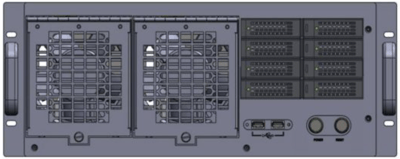 Our new server solves a persistent problem in simulation, data acquisition, and FPGA-heavy environments: how to host numerous PCIe cards in a single system without overwhelming power, cooling, or rack space.
Key benefits include:
- 16 full PCIe slots in a standard 4U chassis
- Single power cable operation with manageable thermal output
- Full VM compatibility for virtualization and pass-through use cases
- Customizable barebones design to support unique hardware setups
One of our early adopters consolidated three servers into one with this platform, reducing space and power consumption significantly. For field, mobile, or space-constrained deployments, this level of efficiency is game-changing.
Let’s Connect at the Show
I/ITSEC attracts the simulation engineers, integrators, and technical leaders who understand these challenges best. If you're attending, we would love to meet and talk through how our solutions might support your work in virtualization, training systems, or mission-specific compute infrastructure.
Reach out ahead of time if you'd like to book a meeting with our team. Otherwise, come by Booth #275 and let’s start the conversation.
Thanks again to ICY DOCK for their support and for helping us tell the story of rugged, high-performance virtualization done right.
We’ll see you in Orlando.