

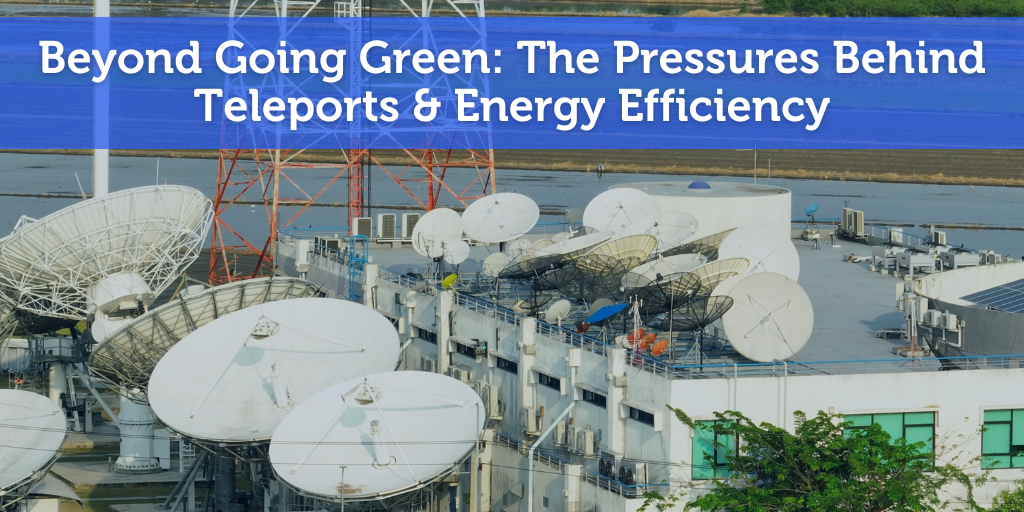
Energy efficiency in SATCOM tells a story that's far more complex than simple environmental consciousness. While teleport operators worldwide are investing in greener technologies and practices, the driving forces behind these initiatives reveal a pragmatic calculation that extends well beyond sustainability branding.
Energy Costs: The Bottom-Line Driver
Power is among a teleport’s largest operating expense across antenna control systems and satellite ground station infrastructure. These facilities run heat-dense baseband rooms and industrial cooling 24/7, feed high-power RF chains that throw signals tens of thousands of miles into orbit, and keep UPS systems and backup generation ready at all times for satellite communication systems. When rates jump or fees swing, the hit lands directly on margin.
The pressure has been building for years. Europe’s price shocks in 2022 made headlines, but the larger story is persistent volatility almost everywhere. For sites drawing into the megawatts, that volatility translates into month-to-month budget risk.
Some operators have passed costs through to customers and paid for it competitively; others have absorbed them and watched margins erode. Either way, unmanaged energy spend is now a strategic liability.
The AI Revolution: Unprecedented Competition for Power
The rise of AI is turning the grid into a competitive landscape. Hyperscale training and inference campuses are locking up firm capacity and pushing interconnection queues to record levels. New substations, feeders, or transmission don’t appear on quarterly timelines, which means demand can outpace supply for years at a time.
For teleports, the implications go beyond higher bills. In constrained markets, reliability risks and peak-period curtailments creep into operational planning for custom antenna systems. When megawatts are scarce, the cheapest and fastest capacity you can “build” is the capacity you no longer need, through better RF efficiency, tighter controls on de-icing and HVAC, and smarter power architecture in baseband spaces for antenna control systems.
Customer and Corporate Mandates
Procurement is starting to change in SATCOM and government technology solutions. Enterprise and government customers increasingly write energy and emissions criteria directly into RFPs, and large buyers cascade carbon targets through their supply chains. Public companies face investor expectations around ESG, and parent organizations are setting site-level targets for energy use, emissions, and renewable adoption.
For operators, that will shift environmental performance from differentiator to gatekeeper. Winning and keeping key contracts will start to depend on being able to measure, improve, and credibly report energy performance. The challenge isn’t only technical; it’s also organizational, aligning engineering, finance, and sales on the same operational metrics.
Capital Constraints: An Implementation Challenge
The business case for efficiency is clear; the CapEx often isn’t. Modernizing HPAs, re-architecting cooling, or adding storage and advanced controls can require multi-year budget planning.
Older sites can compound the difficulty: retrofits may demand electrical and mechanical rework before new equipment can deliver promised gains. Meanwhile, shifting revenue models, LEO growth, changing service mixes, make boards wary of big bets with long paybacks.
That caution is rational, but delay is costly. The operators who make progress tend to break investments into sequenced packages that hit the largest loads first and show verifiable savings quickly, so each phase funds the next.
Skills and Knowledge Gaps
Today’s savings are as much about integration as equipment. Sub-metering, telemetry, and analytics need to be in place to target the biggest kWh; de-icing must be treated like a controllable industrial process, not a binary switch; baseband rooms benefit from data-center practices around airflow, set points, and part-load efficiency.
Smaller teams don’t always have this expertise on staff, which can stall projects or blunt results. Building a small internal core, augmented by selective vendor and integrator support, often determines whether upgrades pay back as modeled.
Efficiency as Competitive Advantage
Leading operators are starting to reframe energy performance as an operating system, not a side project. They design for it up front; weigh RF linearity, back-off, and power-added efficiency alongside link budgets; tune heaters and controls with the same rigor they apply to availability; and manage baseband rooms with data-center KPIs. Financing follows strategy rather than dictating it, leases, incentives, and performance-based contracts help smooth CapEx while locking in verified savings.
The common thread is governance: clear ownership of energy metrics, routine reviews in ops meetings, and transparent reporting that sales can carry into procurement conversations. Efficiency reduces OPEX, yes, but it also protects uptime when the grid hiccups and strengthens bids when customers ask hard questions.
The New Energy Reality
SATCOM economics are shifting around power. Prices are higher and choppier than they used to be, capacity is harder to secure, and credibility on energy metrics now affects revenue, not just reputation. Operators who act decisively, despite capital and staffing constraints, will keep margins, improve resilience, and stay eligible for the most demanding contracts.
Those who hesitate risk getting priced out or falling short at the compliance hurdle.
Build Sustainability Into Your Ground-Station Strategy
Energy efficiency is becoming inseparable from overall teleport performance. While operators weigh upgrades across RF chains, cooling, and power management, control systems and beacon receivers remain the backbone that keeps sites reliable, precise, and compliant under changing conditions.
If you’re evaluating new control systems or beacon receivers as part of your ground-station strategy, we can help. Request more information today.