

.png)
Earlier this month, innovators and defense leaders gathered in Norfolk, VA for MODSIM World 2025, an event dedicated to modeling, simulation, and digital twin technologies for government technology solutions and military applications. For those who couldn’t attend, here’s a look at the standout themes, conversations, and connections that shaped this year’s conference.
An Intimate but Impactful Event
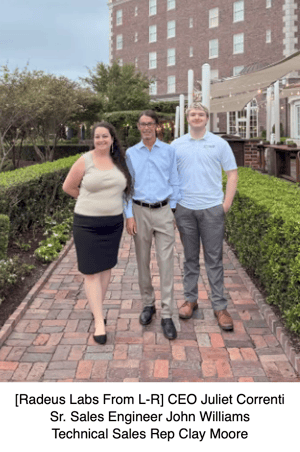
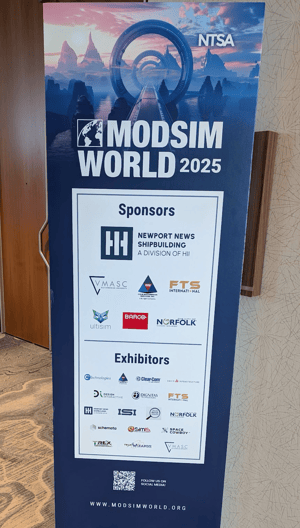
Unlike larger trade shows, MODSIM kept things focused with just 16 exhibitors and three session tracks - industry, defense, and education.
The smaller scale gave attendees like our Radeus Labs team the rare opportunity to have meaningful one-on-one conversations with nearly every exhibitor, from emerging tech startups to established defense partners.
Local presence was strong, with organizations like the Virginia Modeling, Analysis, and Simulation Center (VMASC) driving conversations around academic partnerships and government collaboration.
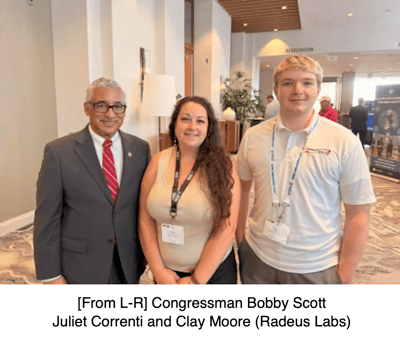
Congressman Bobby Scott, long a supporter of the modeling and simulation community, also made an appearance and delivered a keynote, reinforcing the region’s reputation as a hub for defense innovation.
Standout Companies and Sessions
 Here are a few of the companies and sessions that stood out to our team:
- SimIS – This Virginia-based autonomous training vehicle company drew attention both for its technology and its role as part of the regional industry association with VMASC. Conversations explored how autonomous systems are being integrated into training and simulation environments with AI powered platforms.
- Brelyon – Tackling one of VR’s biggest challenges, motion sickness, Brelyon introduced its groundbreaking 3D monitor technology. By removing the need for headsets, the system offers immersive training experiences without the fatigue common in VR setups, making it a standout for aviation and automotive simulation with computing systems built for demanding environements.
- Argano & Emerging Technology Support, LLC – Together, these two groups delivered sessions on blending digital infrastructure with emerging simulation needs. Attendees noted their ability to bridge the gap between the highly technical and the practical, making complex ideas accessible.
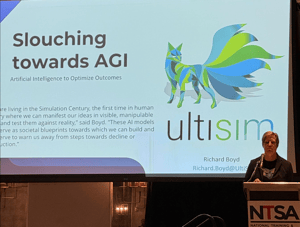 UltiSim Inc. – CEO Richard Boyd delivered what many attendees, including our own team, called one of the best talks of the event. His session covered the early days of MODSIM, the rise of artificial intelligence, and how transformer architectures have driven today’s explosion in AI capabilities and AI servers.
AI, Wargaming, and Real-World Lessons
Artificial intelligence was a central theme across sessions, not just as a theoretical tool but in practical demonstrations across computing systems, from ranking Magic: The Gathering decks (an example for the gaming attendees) to simulating semiconductor manufacturing.
One session highlighted the limits of AI when divorced from human context, using a traffic light analogy: while a traffic light isn’t the most efficient tool for managing traffic, it remains the best for humans because it’s simple and universally understood. The lesson was clear: algorithms can only go so far; pairing AI with human judgment is essential for success in real-world environments.
Wargaming also had a strong presence, with high-level talks examining tactics and strategy development for military applications and aerospace simulation environments. Though more defense-focused, it underscored MODSIM’s role as a crossroads for academia, industry, and government.
Next Stop: AUSA 2025
 As valuable as MODSIM was for diving deep into AI, simulation, and training innovation, the Radeus team is already looking ahead to our next stop: the AUSA Annual Meeting & Exposition in Washington, D.C, Oct 13-15th.
Known as the Army’s most powerful event, AUSA brings together:
- 44,000+ attendees
- 750+ exhibits
- Delegations from 92 countries
This year’s gathering is especially meaningful as it marks the 250th birthday of the U.S. Army, celebrated under the banner “This We’ll Defend.”
We’re excited to join the global defense community in exploring the latest land power technologies, connecting with decision-makers, and showcasing how rugged, mission-ready computing and high density, lower power servers can help shape the future of national security.
If you're going to AUSA, we'd love to speak with you. Feel free to schedule a meeting with the Radeus Labs team. See you in D.C.!